We expect history to provide us with explanations – to place the immediacy of experience within a wider story whose terms will be progressively elaborated and illuminated. Political action, which aims at intervening into history and altering its movement, has an entirely different kind of truth – a subjective truth produced in the act of participating.
The events of yesterday in Oakland, on the other hand, strike me as unintelligible. And I am not sure further information and speculation will shed more light on my experience. The actions we take to develop certain possibilities present in yesterday’s “general strike” may produce a language that will contribute to the intelligibility of future events.
It’s not surprising when the propaganda machine takes advantage of this kind of ambiguity to totally distort reality. But it is obscene, idiotic, and criminal.
Before I left for a nighttime trip to Oscar Grant Plaza, the New York Times website had this as its leading headline: “Oakland’s Port Shut Down as Protesters March on Waterfront.”
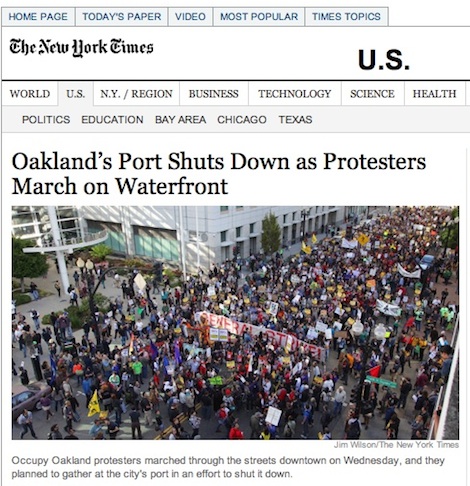
When I got home last night the headline had shifted to “Protest in Oakland Turns Violent,” with essentially the same text. As of this morning, this headline is accompanied by a photo of a man waving a flag in front of a fire, with no explanation of the nature of the fire. It describes “a roving group of about 100 mostly young men” who “broke from the main group of protesters in a central plaza and roamed through downtown streets spraying graffiti, burning garbage and breaking windows.” The police, we are told, warned these vandals to disperse, and then fired tear gas.
All over the internet liberals are warning of agents provocateurs who are trying to discredit the movement, or condemning the dangerous anarchist element that seeks confrontation with police. Such positions could be debated if they had any bearing on reality.
I will try to reconstruct the day. My account will be impressionistic; it will be marked with bursts of fragmentary analysis. The chronology is framed by three hegemonic elements.
Black Bloc
I arrived in Oakland just in time for the anti-capitalist march at 2PM. “Anti-capitalist” seems like a broad umbrella term, and in some ways it is; there were red flags in the crowd, but also people with mainstream signs, including some who seemed to be from unions and nonprofits, who are perhaps beginning to ask some fundamental questions.
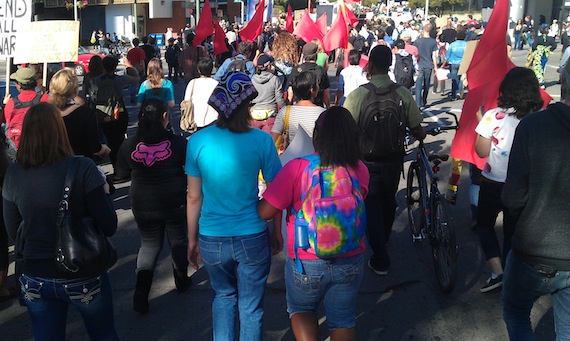
But “anti-capitalism” has a very specific meaning at a protest. It typically refers to the militant wing associated with the 1999 WTO protests in Seattle, and it’s a good indication of the presence of the “black bloc,” the ninjas of the American left who wear masks and break corporate windows.
The black bloc was there yesterday, and they met expectations. I saw windows and ATMs broken at Chase, Wells Fargo, and Bank of America. Bank of America had “1946″ spray-painted on one of its totally shattered windows, to recall the previous general strike in Oakland.
I saw no police. I saw no arrests for property destruction. I want to emphasize this, against reactionaries who smear the whole movement by reducing it to one element, and against liberals who think that police violence simply brought a minority of extremists under control. Property destruction did not start at midnight when the tear gas came out. The majority of property destruction – the only property destruction I personally saw – took place in the afternoon with no police response.
Moralizing reactions to the black bloc are absurd, but I believe it must be evaluated from the standpoint of strategy. Property destruction is not the same as violence against people, and if destroying the windows of a bank reduced the predatory exploitation practiced by these institutions it would be ethically unimpeachable. Unfortunately, I see no way in which it does that. Black-bloc property destruction seems above all else to be a form of self-expression. It does not fit its tactics into a long-term strategy, and it does not move towards dismantling the social structure of capitalism, rather than the physical structures that sometimes represent it. Neither does the highly secretive and elite grouping of the black bloc prefigure communist relations.
This does not mean, however, that we should misrepresent the composition and practice of the black bloc. During the attack on Wells Fargo, a man bicycled up to the barricade, pointed, and said, “some of you are cops.” He repeated it knowingly and biked away. Countless people who weren’t there are saying this on the internet today. But to me it seems totally implausible.
First of all, two police informants were identified. I have no way of confirming whether they were undercover. But they sure seemed like it. A woman pointed at two rather burly men, one white and one black, with aggressive postures and clothes that seemed exactly like what a police officer would imagine a protester to wear. She said they had been picking up items people dropped to use as evidence; they could come up with no better defense than to say, “I ain’t undercover,” and accuse the woman of not being from Oakland. (She was not in the black bloc.) If these two men were police – which, given previous Oakland Police Department (OPD) policies, is not farfetched – they were literally the only police I saw that afternoon.
A few minutes after hearing this exchange I saw a gathering in the street. One of these men had been encircled by the black bloc, who were shouting and pounding the road with their sticks. He left rather quickly. I have tried a few thought experiments, but I can’t quite understand why the OPD would send infiltrators of varying quality into the march, turn them against each other, and then do nothing when the windows actually got broken.
The second important point is that the black bloc did extremely organized hits on specific sites. It was not wanton destruction. They attacked no local shops, no street lights; not even Starbucks. They targeted banks and did so with efficiency and focus.
The only location they attacked which was not a bank was Whole Foods. They managed to splash paint on the windows; as far as I saw they had not actually broken the window. It was when we passed by Whole Foods that I first began to hear the crowd chant, “peaceful protest.” This was the mainstream of the crowd, the ones wearing union t-shirts or holding signs about campaign finance reform, who had for whatever reason decided to join the anti-capitalist march. Some of them physically protected the Whole Foods and the black bloc had to move on.
“Peaceful protest” is a meaningless chant, incoherent and potentially reactionary. At best it is a call to present a media image that will please those who are already against you; at worst it is a defense of private property won by exploitation. The response from the black bloc, however, was somewhat incredible: “union busting is disgusting.”
Black-bloc anarchism does not tend to align itself with union politics. But the idea that the black bloc should use focused property destruction to defend the right of workers to unionize gives a totally different picture than the one we see in glib liberal commentary.
What we will have to accept is that the black bloc is our closest current model of vanguardist organizational principles, in a range of contradictory ways. They are a select coterie of individuals who attempt to enact the contents of their “advanced” consciousness. What is missing is the interchange between the vanguard and the broader mass of workers – especially the elements of the broader mass that are alienated by these tactics. Those who call uncritically for a party today will have to ask themselves if they are prepared to embrace a line that runs from Stalin the bank robber to the black bloc; I don’t mean to discredit leadership or underground activity, but simply to emphasize that history does not fit neatly into our prejudices. Those who reject organizational structures in general will have to ask themselves if they believe it is consistent with anarchist principles to impose their tactics upon the workers for whom they claim to speak. Perhaps serious strategic answers to these questions will bring more people into anti-capitalist marches.
Longshoremen
The next event, at 5PM, was the march on the docks. The dock workers of the Bay Area were the ones who led the way in the 1934 general strike in San Francisco, in the union that later became the International Longshore and Warehouse Union (ILWU). Oakland was the first major American port on the Pacific Coast, and is still the fifth busiest in the country. This is not only the site of a history of militant labor struggle, it is also a nodal point of global capitalism.
This was a far more diverse march than the one I had been in that afternoon. Not only was it extremely inclusive, with families, union members, and a whole range of young and old participating, it was far larger. I believe the police estimate was 7,000; some have gone as far as to suggest 100,000 participating throughout the day.
The path we walked along was dotted with several stationary trucks that had come to pick up shipments. It is certainly possible, as some reports suggest, that there were truck drivers who were angry. But I didn’t see any of them, and I saw a lot of truck drivers. Most of the ones I saw were honking their horns, smiling, taking pictures, and raising fists.
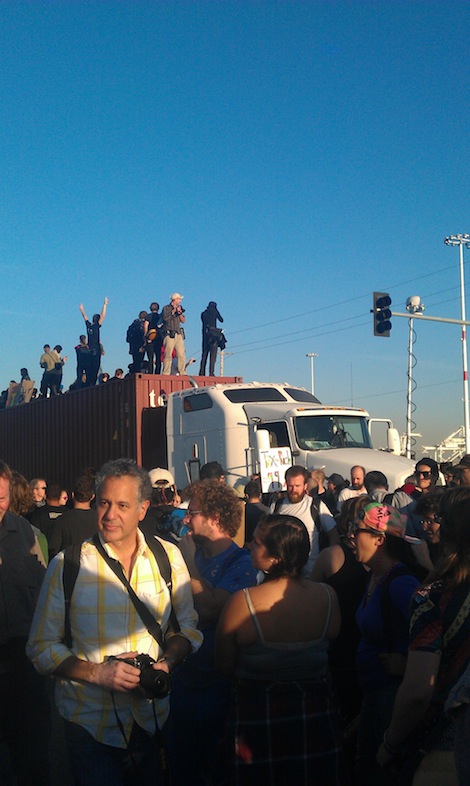
As we marched, we had to navigate the huge and complex geography of the port, and our numbers were divided as we went on. Periodically we stopped and the people at the front called mic checks. Nobody could hear the human mic. Decisions had to be made, but it was hard to understand what they were, and who was going to make them. I got the impression that the leadership was discouraging us from going to the docks, and wanted us to return to downtown Oakland to build an ongoing strike there; others did not get the impression that they were biased in either direction. We also seemed to be debating whether to go to the bridge to march to meet Occupy San Francisco. Sometimes other people spoke, and one person said that the dock workers needed our support. People chanted, “shut down the ports,” and we headed that direction.
Dock workers sign up for jobs and get tickets indicating the time of their shifts. There are some reports that many workers simply did not take jobs yesterday morning. But others did. When we finally arrived at the port there were police at the very end of the path, but the important space was the parking lot where the workers were waiting. We gathered in that space and did several mic checks. Someone who seemed to know how the union worked reminded us that like most other unions, ILWU workers could not simply choose to join a general strike; but they do have a contract which allows them to refuse to cross picket lines. He said we needed to form a picket, potentially for a couple hours, until the union sent an arbitrator to determine whether the workers could go home.
We went to talk to the dock workers, who were all watching the scene with interest and waiting to see the result. They were happy to talk to us. One told us that we had to stay until midnight; better, until 3PM the next day; best, until the weekend. He explained their scheduling and suggested that we needed to interrupt several consecutive shifts to seriously interfere with the shipping schedule. The dock workers had already been engaged in a slow-down, for several weeks – or months, I don’t remember. Since they were being pushed to put a larger portion of their pay towards medical benefits, they were using every possible technicality in their contracts to avoid doing tasks, and generally just driving too slowly.
He hadn’t heard about the Occupy movement until he got a call about a potential work stoppage. So he turned on the TV to learn more. “We’re in the same struggle,” he said. “We all work for them.”
We stayed on the picket until the arbitrator showed up. The night shift got cancelled, but workers on another berth whose 8PM shift was cancelled were being asked to report to work at 3AM. This didn’t matter, our contact explained; since their tickets said 8PM, they could simply refuse to come.
The picket line parted so the dock workers could drive home, which they did to cheers and applause. They did not join the picket – this is a reasonable choice, since they have lives to live that were momentarily liberated from work. I was immensely proud to have participated in a picket that allowed two shifts to refuse to work, and to have shut down this center of the global market for probably 24 hours – to have actually, in some small sense, interrupted the daily operation of capitalism. But I did wonder how the militancy of the dock workers could be incorporated into the general movement beyond that day, and how we could have been better prepared to find them and work with them.
Tear Gas
First you hear the cartridge cracking through the air. By that point you should already have your mask and goggles on. It’s not so much that the air changes, as the funny feeling that your throat and eyes have suddenly started to malfunction. The atmosphere is filled with the chemical particulate but also a spontaneous camaraderie, homemade remedies passed around and people leading each other to safety. It is hard not to recall the words of Antonio Negri in Domination and Sabotage:
Nothing reveals the immense historical positivity of the workers’ self-valorization more completely than sabotage, this continual activity of the sniper, the saboteur, the absentee, the deviant, the criminal that I find myself living. I immediately feel the warmth of the workers’ and proletarian community every time I don the ski mask.
But this time it was not sabotage that counted. Let’s all take a moment to remember that the police launched the tear gas at midnight. The black bloc did not set up tear gas canisters at 3PM to explode later in the day. If you blame the black bloc for police violence that happened nine hours later, I don’t know what I can do to help you.
What mattered instead was this “self-valorization,” a term closely tied to the establishment of “occupied self-managed social centers” in 1970s and 1980s Italy, when young radicals went beyond refusing work; they squatted in abandoned buildings and established cultural spaces, some of which still exist today. This was the autonomous productivity that the police came last night to suppress. A group of activists had occupied a building that used to house the Travelers Aid Society, a nonprofit that provides shelter and services to the homeless. Due to funding cuts the organization had lost its lease; the building was abandoned.
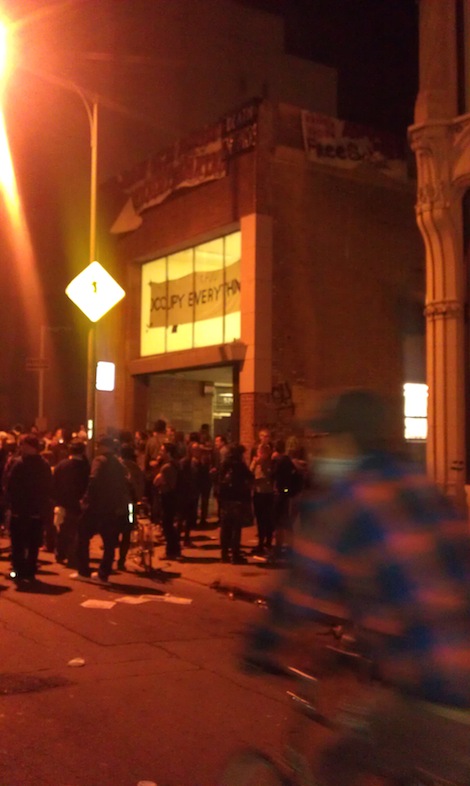
The occupiers wrote:
In this abandoned building that once provided services to those in need, we open the Occupation Crisis Center… We are reclaiming space that has been unused, used against us, left empty while we sleep outdoors, while we cook and organize and struggle outdoors.
This morning, they wrote more about their plans:
We want this movement to be here next Spring, and claiming unused space is, in our view, the most plausible way forward for us at this point. We had plans to start using this space today as a library, a place for classes and workshops, as well as a dormitory for those with health conditions. We had already begun to move in books from the library.
I did not enter the building, but some comrades did. The space was being reconstructed; someone brought speakers and a dance party started on the street in front of it. By the time I arrived, about 11:30PM, the mood was shifting; everybody knew the police were on their way. The Alameda County Police came first and were later joined by police from around the Bay Area (including, as far as I know, the OPD).
The protesters were not attacked for engaging in vandalism. They were not attacked for property destruction. They occupied a building; they erected barricades to defend the building; they lined up in front of police to defend the building.
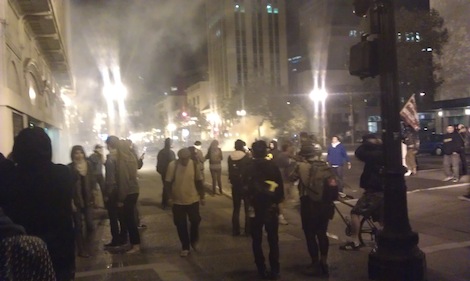
I don’t know when the fires started. We were hit with tear gas at least three times, starting a little after midnight. We stood in Oscar Grant Plaza and took off our masks, and a woman came by and told us a fire had just been lit. This was the first I had heard about fire, but I had not actually seen the front lines where the police were. What’s important to understand is that reports were coming in through Twitter and elsewhere that police from around the Bay were massing, with full riot gear, with their badge numbers blacked out. The occupiers were on the defensive. The goal of lighting fires was to use smoke to reduce the effects of the tear gas. Whether this was done after the tear gas was launched, or before, in anticipation of a brutal attack like the one last week, strikes me as completely and radically irrelevant.
I left at about 1:00AM, after which the violence escalated and the police swarmed upon the camp in Oscar Grant Plaza. My understanding is that they ejected the occupiers by entering the building by the roof. Some protesters fought back, and at this point apparently broke some windows and threw bottles at police. The police reacted by shooting beanbag bullets, hitting an unarmed homeless man in the leg, and launching flashing grenades and more tear gas.
I have no further details about the extent of the property destruction that took place early this morning. What I do know is that it was a response to police violence.
What matters here is that police violence was not a response to any act of vandalism. It was an attempt to repress the occupation of an abandoned building, and its conversion into a social center for the occupation.
We are at a moment when occupations are seriously considering an expansion of strategies. Everything in this movement points to the occupation of spaces that are in a state of disuse caused by foreclosure and budget cuts. The state is attempting to delude you into thinking that it uses violence to prevent destruction. Do not let them mislead you. Last night it used violence to prevent the production of a new space. And if you let it put the blame on Oakland, you will help it one day bring that violence against you. You will help them defend capital’s destruction, the further hollowing of the urban landscape and the expulsion of human bodies onto desolate streets.
I suggest refusing to blame Oakland, but simultaneously shelving property destruction as a tactic. The police didn’t care about it. The banks have money to repair their windows. What threatened the state was the creative restoration of the city. Imagine a strength that could force the state to retreat: a mass movement that walks out of work and occupies everything.
Asad Haider is a graduate student at UC-Santa Cruz, a member of UAW 2865, and an editor of Viewpoint.


At Tear Gas is where your story picks up. The rest is mostly pointless and boring. You’re a good writer–if a little hung up on your Berkeley graduate degree–and I don’t know how much you’ve skewed it, but please keep writing. Keep telling the story.
love
nate
Posted by nathangreen | November 3, 2011, 7:56 pm@nathangreen
what, are you his TA or something? silly and distracting comment.
Posted by axa | November 3, 2011, 10:22 pmNate,
Totally agree with you that it’s great Asad is telling his part of the story, but I’d caution that just because you did not find anything significant in the beginning of the article, this does not mean that everyone will find it “pointless and boring.” Personally, I found the section on the black bloc to be very helpful for thinking about what happened yesterday, why black bloc tactics are sometimes used, what their consequences are, and what that means for future strategy. Asad, thanks so much for sharing your account and analysis.
-Aaron
Posted by Aaron | November 3, 2011, 9:35 pmVery thoughtful reflections, Asad! I appreciate your patient cataloging of the events of the day and your analysis. I disagree slightly on the timeline question, though. I don’t think it’s that OPD didn’t care about vandalism so much as they were prepared to manipulate the whole thing cynically. They did the exact same thing during the Oscar Grant protests – they sat back while vandalism was occurring, doing nothing, and then blamed much later operations on the need to protect the city from vandalism. If the occupation of the Travelers’ Aid building hadn’t occurred, they might not have had a pretext to teargas people last night, but city officials and the mainstream media still would have used the vandalism as a reason to bait anarchists and press to evict the occupation again. I’m not sure how that would effect your analysis one way or the other. I agree that serious, long-term building occupations are something for this movement to consider. The politics of property and policing in the US have long been such that this kind of thing has been very difficult to imagine – we’re neither Latin America nor Europe. Yet this movement has already remapped what’s possible. Perhaps this is next. Last night shows that it would require a serious effort involving thousands of people at times and hundreds of people on a regular basis, as well as a narrative that builds support for it in the broader community.
Posted by Adam Hefty | November 4, 2011, 12:26 amI want to point out to readers that I saw a bandana-clad Adam in the plaza that night, and he had been there all day. He is speaking from experience and what he says is very important. Vandalism is a pretext for the police; they don’t try to prevent it, they try to use it to justify their violence and manipulate the media response. What they’re afraid of is the possibility that this movement will keep spreading.
Posted by Asad Haider | November 4, 2011, 8:52 amJust wanted to say that reading this was helpful in understanding the more militant-seeming protestors, the ones with scarves over their faces, and so on. But I am one of those condemning the acts of vandalism, and I, having witnessed it firsthand, disagree that the anarchistic element isn’t seeking confrontation with the police. You’ve created a dichotomy between “normal” protestors and the black bloc while attributing all acts of vandalism to the latter. The anarchistic element isn’t limited to the black bloc; there are others here, self-proclaimed anarchists, who are vandalizing and provoking police with more abandon. Don’t insult those who call out this element by saying this argument has no basis in reality. I find your perspective interesting and enlightening, and you adequately substantiate your claim that if there are agents provocateurs, they aren’t in the ranks of the black bloc. But I wonder if you have witnessed firsthand all incidences of police confrontation. Were you there last week? If you were, I don’t think you were looking hard enough. If the black bloc is as organized and comprised of such an elite group as you say, then I would assume that it took some time and planning to bring their ranks to Oakland for the general strike; the protest following the raid on the encampment happened spontaneously, and there was a profoundly antagonistic tone toward the police, as well as many acts of arbitrary vandalism. Again, it is helpful to know that the actions of the black bloc are based in deliberate and thought-out intentions, which I did not realize, but I think you are glorifying them. Was the abandoned building locked? Did they break in? From the standpoint of the law, breaking and entering is generally more severe than vandalizing.
Posted by Erren | November 4, 2011, 12:28 amI hope more people are writing first person accounts of the Occupy Wall Street movement. The collective written histories are what will shape how this is documented for generations to come. My biggest hope is that the ‘official’ histories will be ‘bottom up’ accounts, rather than top-down.
I am not here to critique your writing ability but as someone in the Midwest looking for insight into what it was like from a participants view. Videos are wonderful, but the context is lost without the written word beside it, I would like to say that your analysis seems through and balanced,with references (or links to them) provided. One perspective
Other perspectives I am curious to see is a written account by 2 OPD police officers:one aligned with the occupation, and one against. I would like to know from a first person account how a sympathetic police officer deals with that kind of conflict. Oh, there will be so many books written…
Well done, keep it up.
Respectfully,
Lesa (Occupy Iowa City (IA).
Posted by Lesa Key Frantz | November 4, 2011, 12:42 amSigh. I need to make some points:
1. This is America, right? Theoretically, we should all be free to be politically anarchist. And, I know a lot of political anarchists that didn’t break any window or spray paint anything other than cardboard signs. Some of them even make jam – so let’s chill out on the anarchist-as-slur shit. That’s so 1999.
2. Black bloc is a tactic, not a group of specific people. And to say that they are “elite” is laughable. If only! My Euro buddies tell me that US black blocs are pretty inept. And yes, I was there late Wednesday night and last week and some of the Oscar Grant stuff. Tear gas! It clears your pores.
2b. Last Tuesday really was quite peaceful. I saw no more vandalism in the streets than on a normal Oakland Tuesday and we all really got beat up that day.
3. The fire definitely happened after the first tear gas canister. The big fire anyway, there very well could have been little trash can fires before that.
4. I will totally admit that there are people at protests who want to provoke the police. Though, I don’t. Have you ever stared down 500 riot cops? That shit’s scary.
5. I also met two people last night that think that all riot cops are holograms. Food for thought, yes?
6. As for sympathetic OPD …I would also like to find one and talk to him/her. I won’t hold my breath, though. Let’s remember, too, that the majority of these riot cops come from outside Oakland – San Mateo, Fremont, Hayward, Walnut Creek, CHP, BART, Alameda Sheriff, etc…..so different levels of experience.
Finally, let’s all consider the possibility that the Occupy Oakland encampment wouldn’t exist without anarchists and others we might disagree with tactically. And that encampment wouldn’t have been raided, wouldn’t have gotten on the news, wouldn’t have had 1600 people at a GA call a strike. Who do you think made those photocopies? And passed them out? And liaised with organizers within the ILWU? They even knew that the ILWU had a community picket clause – that shit is RARE. Essentially, like it or not, the people who got this shit off the ground to shut down the port and have happy-peaceful-march-fun-time are going to be a little more extreme in their tactics. And in my mind, that’s a good thing because I don’t have the courage/dedication to do it but it’s about damn time someone did.
Posted by Jessica | November 4, 2011, 1:12 amExcellent points Jessica! Thanks for sharing your views. Particularly about Anarchists. My son is of that persuasion and I don’t see him smashing in windows and painting… well, maybe a tag or 2 here and there, but def not in broad daylight. My older son lives in Oakland, I always hope to catch a glimpse of him on a video.
Fortunately our city is being, if not enthusiastic, at least fairly accommodating, as they said, “For Now”. They will be letting us set up a few 10 man Arctic tents and use a heat source the Fire Marshall approves of… so we will see how we fare in the hellish Iowa winter.
Stay Strong.
Posted by Lesa Key Frantz | November 4, 2011, 3:04 amAs I understand it, Boots Riley was one of the driving forces behind targeting the port and researching the union details.
Posted by x | November 4, 2011, 1:00 pmas i understand it, having been there for the meeting of the general assembly the night we voted wholeheartedly in support of a general strike, with over a thousand people voting, we all were the driving force behind targeting the port and researching union details. meetings happened every day and night after that vote to plan this event.
each person has agreed repeatedly that we will not be followers, and that, as leaders, we will take on responsibility for the bulk of the work load of this movement. yes, some people had those connections to get answers and support from the unions out there, and yes, boots had (and also refused to share) the megaphone throughout most of the march. partly that is because he had the time to be involved in the tactical committee that designed the route.
you taking up space to give one person credit for what over a thousand people helped plan and probably ten to twenty thousand people helped execute is exactly one of the problems we face.
one of our deepest strengths is our refusal to identify individual leaders whom the powers that be can then attempt to bribe or otherwise influence. boots riley is as committed as am i to this movement, but does not speak for us all. the tactical committee did an enormous amount of work to help make this happen, alongside many other committees. the word::: committee, indicates commitment. and while i don’t come to judge and blame, i believe the tactical committee, as well as all of us, learned alot about how to plan and execute the next major action! we all did a great job!!!
Posted by wiseold snail (@wiseoldsnail) | November 6, 2011, 2:39 pmGreat article, interesting points and a sense of comradely engagement. Only just came across your publication and am glad I have.
Keep it up
Posted by Resonance | November 4, 2011, 3:23 amIt’s Frank Ogawa Plaza. No need to disrespect the Asian American community in the quest for justice for all communities.
Posted by Chanda | November 4, 2011, 7:33 amI am actually Asian-American. You raise an important question; here is a response from Oakland, 1969: http://blog.angryasianman.com/2009/07/yellow-peril-supports-black-power.html
Posted by Asad Haider | November 4, 2011, 8:30 amGood article. Your point about what the police did and did not react to is thought-provoking. I do wonder if there is also an element of randomness and confusion in terms of police actions and reactions — they are getting mixed signals from the inept leadership of Mayor Quan.
Posted by J.D. Moyer | November 4, 2011, 11:51 amInteresting analysis of the day. No mention of the communities of color that played a role in the demonstrations. Also for Jessica, “Who do you think made those photocopies? And passed them out? And liaised with organizers within the ILWU? They even knew that the ILWU had a community picket clause – that shit is RARE. Essentially, like it or not, the people who got this shit off the ground to shut down the port and have happy-peaceful-march-fun-time are going to be a little more extreme in their tactics. And in my mind, that’s a good thing because I don’t have the courage/dedication to do it but it’s about damn time someone did” denigrates the organizing day to day outreach and community building work that organizations in Oakland, like Just Cause, like AYPAL like Youth Together, like the Oscar Grant Committee have been doing way before Occupy anything. Food for thought.
Posted by Liz Derias | November 4, 2011, 12:33 pmYeah, I realized in hindsight that that was problematic. I certainly wasn’t trying to say that many, many groups (even groups I am affiliated with!) didn’t also do a TON of organizing – probably most of the organizing. So I apologize for not making that clear. The point was recently made to me, though, that we often hear in the media that events are organized by “peaceful protesters” and then the “anarchists” or “outside agitators” come in and ruin everything. In reality, the situation is much more complex than that – using militant tactics doesn’t mean a person isn’t organizing in other ways or a member of the community. So, again, I apologize for exaggerating for effect and leaving out the contributions of many other people.
Posted by Jessica | November 4, 2011, 12:51 pmIf you blame the black bloc for police violence that happened nine hours later, I don’t know what I can do to help you.
—
http://www.indybay.org/newsitems/2011/11/03/18697018.php?show_comments=1#18697297
Here’s what I saw and heard that instantaneously made it crystal clear that police would HAVE to show up at the scene en masse: (1) While at the 16th Street dance party, I kept hearing loud bangs from the direction of Telegraph/Broadway. After jerking my head around each time and not seeing any signs of movement/destruction/police, and after hanging around long enough to hear three of these bangs, each separated by minutes of quiet, I picked my way through the still-cool crowd out to the corner of Telegraph. This is where (2) I saw a bunch of fucking bullshit so-called “anarchists” in their trademark black skinny jeans/hoodies/face bandannas — where not in full on ninja-wear — who were in the process of dragging in and tipping over dumpsters to form the backbone of a barricade along Telegraph/blocking off 16th. The barricade was roughly waist-high to me and predominantly composed of tipped over shopping carts and wooden crates and pallets (“liberated” from Walgreens or RiteAid on Broadway? I didn’t think it particularly intelligent to stick around to inspect more closely). I then heard one of these douchefuck provocateurs, standing to my left as I paused to take a photo, say to a colleague: “We need to set this shit on fire.” Thinking that being anywhere near any fire would be a terrible idea, lest I get burned or trampled or god forbid any of the surrounding buildings accidentally go up in flames, I immediately left, heading north on Telegraph. Of course, I know now from media photos that multiple fires *were* set shortly thereafter, so that these fuckwads could elevate the utterly pointless and aggressively confrontational — sorry, for these faux-anarchist riot groupies who lack higher-reasoning abilities, aggressively eliciting confrontation IS the point — barricade bullshit into a full-on supplication to riot gear-clad police and sheriffs to hurry up and beat down the totally PEACEABLE Occupy protesters. Congratulations, motherfuckers: it worked.
The beyond-disingenuous, self-fellating propaganda of the faux-anarchist horde is that any opposition to their destruction and endangerment of others — whether in the form of unlawful use of force by a perpetually inept and corrupt law enforcement agency like the OPD, or even as pleas for nonviolence by “fellow” protestors at Occupy Oakland and all the other countless protests these shitbirds ineluctably invite themselves to and strive to coopt — can be dismissed with a wave of the hand as some kind of pro-capitalist fixation with protecting private property above all else. Read a FUCKING newspaper. The 99% includes and works on behalf of the unemployed, the underemployed, and the working poor; the indebted, the underwater, and the foreclosed-on; the economically marginalized and the financially exploited. We GET why occupying and repurposing an empty building, whose very emptiness is symptomatic and symbolic of our bought-and-paid for government systematically failing the 99%, would be a sensible and pretty awesome goal to pursue. We do NOT get what you are trying to accomplish by continually inciting OPD to engage US with the kind of tactics that are going to get their asses tossed into federal receivership come January 2012. Are you trying to educate us on the finer points of the incredibly complex and sophisticated philosophical tenet that “cops = pigs”? This is OAKLAND. We KNOW. And we know you don’t actually believe that “The city spent hundreds of thousands of dollars to protect one landlord’s right to earn a few thousand every month….Whereas the blockade of the port – an action which caused millions of dollars of losses – met with no resistance” because OPD (maybe you mean the mayor? Barack Obama? Ben Bernanke? David Koch?) knows and gives two shits about your retarded third-grade understanding of capitalism (much less your reductionist-to-the-point-of-cultural illiteracy characterization of the role and responsibilities of police in our society).
As everyone with two brain cells has surmised, the port shut-down met with no police resistance because the 10,000-strong participants were entirely peaceful; your firestarter stunt got everybody tear gassed and shot up with “non-lethal” projectiles because you literally set shit on fucking fire. That is not an accident: 10,000 people can hold it together and get through the day, but as soon as 50 of you muster some skull cracking always mysteriously seems to commence? You *planned* for OPD to wild out, you made it happen, and you fucked us all over in the process — repeatedly and deliberately. So do us all a favor and go fuck yourselves. You’re not wanted at Occupy Oakland, and I can’t imagine anyone else who’d have you either. Maybe start up your own, “anarchist”-only protests about whatever it is that really pisses you guys off (we can’t really tell since you pathetically and exhaustingly show up to EVERYTHING, ALL THE TIME), and goad the police to blowing their loads tear-gassing just YOU five times in an hour.
Posted by louisproyect | November 4, 2011, 4:00 pmThank you, LouisProyect. Glad you said that. These assholes came in from God-knows-where and fucked shit up for those of us who’d been marching all damn day, AND for those of us who live and work in downtown Oakland and have to deal with the repercussions of their actions. Thanks to those asshats, I’m now living in a police state. To the fuckers who smashed up the ATM I use (and they smashed the credit union ATM, while leaving the US Bank ATM right next to it unscathed), and who vandalized and broke the windows of my neighborhood grocery store, I say this: STAY THE FUCK OUT OF OAKLAND.
Posted by RyannSierra | November 4, 2011, 8:10 pmHey, this Erren from an above comment. Thank you, I’m glad there are people like you who see what’s going on down there and refuse to apologize or make disingenuous rationales for the behavior of these children. Big ups.
Posted by Erren | November 5, 2011, 11:50 amFirst off, if the police had waited to show up and break up the group of persons gathered to uphold the occupation of the Traveller’s Aid Society until after the fire was lit, then why were they lined up immediately afterward (in full riot gear) if not before? Also passing judgement about the type of person someone is or their political beliefs/goals based off of their clothing choice seems a little misguided. Maybe you just perused the above writing and misinterpreted/disregarded several of the important points brought up by Asad. The point is that police violence was brought down at a pivotal moment to make it seem like the “anarchist”/”black bloc”/some other dark-force-that’s-against-americans is spear-heading the movement and demoralizes the entirety of the days events. The people who occupied the building, and those who lit the fire did nothing to demoralize the movement. I cannot say that I entirely agree with the actions taken that night (lighting the fire, the throwing of bottles and bricks), but what I can say is that they were done in defense of police action, not offense.
Next, it seems rather unlikely that the concrete and brick buildings and pavement road on which the fire was set would somehow explode into an outrageous hellstorm of fire and endanger the lives of people, as any intelligent, reasoning human being should be able to come to the conclusion of. And for those concerned about the peaceful protesters caught in the midst of the tear gas fire: they were warned it would happen. Just as you had the choice, they could also choose to leave, as many did. So in my opinion, even if these as you put it “faux-anarchists” DID incite and illicit the rage of the riot police (which as I’ve stated is not my belief of the situation), they did not put any fully innocent and peaceful protestors into a line of fire.
Lastly, I just would like to say that getting your point across is much more effective when done in an intelligent manner. Fourteen cuss-words (not including my personal favorite: “self-fellating”) and a gratuitous portion of slandering does nothing more than convince me that you are angry and not very good at overcoming your anger.
Posted by Steph | November 5, 2011, 8:47 pmNice response Louis. I wrote a letter on Thursday which was more of a personal statement from my heart. A more feminine approach, LOL. I was really hoping that some of the participants in this mess would realize that they had hurt good people with their actions. I wanted someone to come forward to make a statement that would be an olive branch to the larger movement and help repair the damage to our public image. I can see now that this hope was naive. These people are used to being criticized. They thrive on confrontation, so there is very little chance of getting through to them. They have a lot of theories and fancy talk and a special language. Black bloc is a tactic not a group, diversity of tactics, argue about the definition of “violence” bla bla bla. Semantics is not the point. Their brains are full of catch-phrases and ideology and apparently their hearts are full of rage. I remember being young and angry, so I do understand. I’m glad I never got swept into this scene, because I was very close to it. But I also have always valued creativity, so I’m not good at wearing uniforms and parroting. I would think that the phrase “diversity of tactics” would be an invitation to think creatively. Let’s come up with imaginative ways to send a message using civil disobedience. Let’s make daring statements using bold tactics. This confrontation BS is just the same old same old. And the debate about it, I can now see, will just go round and round in circles, because these folks thrive on it. They love being the bad ones, the black sheep. One of them told me in a recent online conversation that this was not a moral battle, it was all about power and said “I’m not trying to be a better person”. Personally that feels to me like a chilly breeze from the dark side and makes the hair stand up on the back of my neck. Yikes. I just had to leave the conversation. Where can you go when someone does not even value goodness? I feel we have to have principles of service and compassion at the heart of our movement. I am finding other people who want to be brave, bold, creative, intelligent, and generous so we can join our energy and do our part to build this beautiful movement with direct action, support to the camps, showing up at marches, and personal contributions depending upon our individual skills and resources. I know there’s a certain amount of venting that is necessary after an event like this, but I want to move on to make this movement stronger and to elevate it above the snarky snake pit of black bloc debates. Louis, you clearly have a lot of energy and passion and care about this movement on a personal level. I feel the same way. Find your people and plan something great.
Here is the link to my letter:
https://www.facebook.com/notes/tatiana-makovkin/my-letter-to-the-people-in-black-masks-who-like-to-fsu/10150344744046232
Posted by Tatiana Makovkin | November 6, 2011, 7:14 amSorry about the lack of paragraph breaks.
Posted by Tatiana Makovkin | November 6, 2011, 7:16 amI enjoyed reading the details of the events, but it was your political analysis that was especially provocative and insightful. I’m not quite as dismissive of black bloc tactics, as I do not think that everything we do needs to prefigure the new world. I do find that property damage can be successful at “breaking the spell,” and prevailing as an effective symbolic action. That certainly has limited utility, but it’s not disposable either. Other than that, I think you’ve really nailed the politics here. I agree that the next stage of this movement should be the occupation of buildings. I think after we successfully move to that level, building for a renter’s and mortgage strike would really seal the deal. Stay safe, stay strong, and never give ‘em an inch.
Posted by benbrucato77 | November 4, 2011, 8:42 pmIf they really wanted to use the building, they would not have made a spectacle of themselves. They would have moved with quiet discipline to put the building to use in service of the community. Many of these people have identities based on a self-image that fetishizes property destruction and confrontation. It’s not smart tactics and it doesn’t blend well with this mass movement.
Posted by Tatiana Makovkin | November 6, 2011, 6:40 ami am so thankful for this. thanks for your effort. i will be doing my own recollections over time.
having been present on tuesday from early morning throughout the day until just before the final return to the plaza (which i watched online in horror), and also having walked the shield line to the port, i have plenty to say. for now, i only want to congratulate you, and suggest you revisit your comment regarding whether undercover officers would abruptly depart when challenged. i don’t believe the bulk of anarchists are destructive, nor do i believe the bulk of the few who are destructive are necessarily undercover cops. it seems perfectly likely that a couple of cops were present to incite and encourage and witness destructive tactics. as single officers or in very tiny groups, it would be suicide for them to attempt an arrest on those breaking windows. of course they could call for backup, but that would still out them, while also kinda missing the point, which is to encourage and allow several instances of destruction or defacement to occur in an effort to divide the movement, and as excuse for subsequent police brutality.
we all have to try to walk in each other’s shoes. i have alot of opinions on these issues, and am in constant discussion in my effort to be responsible, willing to adjust my opinion to new information.
many of the die hard campers and those present at and teaching the processes of modified concensus are, indeed, self described anarchists. but anarchists have no more claim to this movement than any of us. we are in this together, and absolutely need all of the 99% of this country to step up in support this movement. we aren’t going to accomplish that by destructive action (breaking windows) in the face of successful action (closing the port of oakland!)
i agree with whoever already said that we could’ve taken this building by stealth, and no one would’ve even noticed ’til they were informed that the library is now indoors.
some of us are working diligently, dividing our time between the camp and online and on the phone efforts to take back what is ours::: to reclaim homes and buildings for their previous owners and uses. these efforts should not be undermined by those operating out of simplistic rage. my rage is as real as anyone’s, but i operate with respectful acquiescence to the larger movement. that doesn’t make me a pacifist. it defines me as an adult.
Posted by wiseold snail (@wiseoldsnail) | November 6, 2011, 2:54 pm