“Don’t fuck with the Oakland Commune.” Words which will live forever in history, to be remembered and repeated at every glorious defeat inflicted upon the heroes of the future by mayors, police officers, unions, churches, and children. A letter, signed by the Occupy Oakland Move-In Assembly, promised to respond to the inevitable eviction of an illegal building occupation by “blockading the airport indefinitely.” Tactics only dreamed of by al-Qaeda, within the reach of Occupy Oakland after just four months.
Yesterday these words were at the center of a material practice which brought our movement up against its limits. It’s not a bad thing to meet your limits. It means confronting the possibility and necessity of radical transformation. And this confrontation should be approached with all the courage and resolve on display when a young militant throws a tear gas canister back at a line of police.
Occupy Oakland Move-In Day was to be a historic event, an occupation of a privately owned building by a mass of people, announced well in advance. The literature indicated that “multiple targets” had been identified, and that the site would be “a vacant building owned either by a bank, a large corporation of the 1% or already public.” The goal was familiar: to establish a social center in the building for community use. And in fact a remarkable schedule of events had been planned, a “festival” which could surely have drawn in attention and support.
Every action in Oakland begins with a deceptive innocence, a rally at Oscar Grant Plaza. The numbers were impressive – the mainstream media reports 1000-2000 throughout the day – and a sign that a remarkable cross-section of the city had been waiting for this. But at the same time police were walking through the crowd with a photo album of prominent organizers, along with warrants for their arrest.
Apparently some of those arrested were returned to the rally, and the march set off in good spirits. From time to time you could look across the street and see lines of police on the next block. You could also look up and see their helicopters.
At a certain crucial intersection it became clear that police, who had a bird’s-eye view of our trajectory, were blocking the planned route. In front of us was a quagmire known as Laney College. This was the first moment in which a desperately-needed contingency plan was unavailable. Though the truck with the sound system and furniture was at an impasse, the crowd spontaneously surged onto the unfamiliar campus and had no idea where to go. It wasn’t hard for the police to block the most apparent exits.
Inevitably, there was a mic check and an attempt at a general assembly; the suggestion that we occupy a building on campus was met with appropriate derision by the already irritated crowd. We walked over an extremely narrow bridge and climbed up a hill to the street, where once again we met our friends in blue and had no idea where we were supposed to go. Eventually we walked on a large street to approach the Henry J. Kaiser Convention Center, which was surrounded by fences and cops.
The Kaiser Convention Center is a very large building. It is an obvious and excessively ambitious target. Whether it was a good idea to consider this building at all will be the subject of great debate in the future. What’s obvious is that doggedly pursuing this questionable plan after significant police interference was inadvisable. The front lines, the people with trashcan shields, took the initiative. They grabbed the fence and pulled it down to face the police, who shot off a smoke bomb. Because smoke bombs look a lot like tear gas, they’re a great way to cause a crowd to become even more chaotic. But people were already drifting away by then, trying to find some representative of the leadership to explain plan B.
Every step we made towards plan B brought us towards another line of police. The handheld garage-door barricades and trashcan shields gathered again at the front lines, with a mass in goggles and bandanas behind them. Ominous drumming on parked cars and buckets. An advance on the police, met with flashbangs and tear gas. The crowd advanced three times.
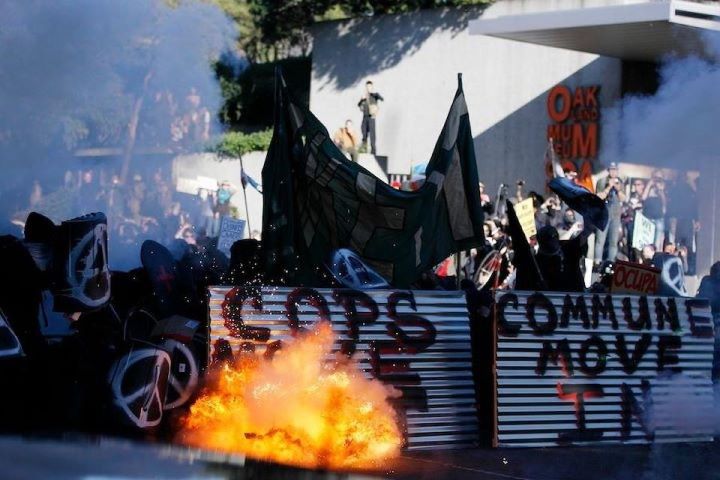
There was nothing much to do after that. A megaphone told us we were going to take back Oscar Grant Plaza, so we walked back there. After a brief moment of recuperation the organizers announced that we would be taking another building in 45 minutes.
I regret to say the atmosphere was triumphalist. It’s understandable that a clash with police has a marked effect on the adrenal glands. But there was nothing resembling a victory in this. The stated goal had not been achieved, and the police are familiar with the aggressiveness of activists in Oakland. They expect it. In fact, the Oakland Police Department is on the verge of federal receivership, an unprecedented move, because the OPD really likes violence, and seeks it out as part of a policy of state-sponsored gang warfare. And the insistence on “Fuck the Police” marches in Oakland leading up to yesterday could only shift the emphasis from the occupation itself to the clash.
Now we have to ask ourselves if we should continue to give the police what they want, which we do in ritualized form at every action. After all, it is these rituals that reproduce belief in the cops. The cops tell a lie. The lie is that their violence is autonomous and imposes its power to preserve an abstract order. What they never want us to understand is that cops are an element of the machinery of the capitalist state, and they exist within a wide network of institutions which allow the capitalist class to exercise social power. In Oakland their repression was used to evict an encampment which threatened to bring public space under proletarian control, and to drive out an attempted building occupation on a day declared to be a “general strike.” And if yesterday the OPD was forced to call upon the Alameda County Sheriff’s Office and city police including Fremont, Hayward, Berkeley, Pleasanton, Union City, and Newark, their actions were structured around the defense of private property and its social system.
But the reinforcement of private property is not limited to police violence. It happens in schools, the legal system, social welfare institutions, non-profit organizations, trade unions, and countless other spaces. Since these institutions don’t use violence to defend private property, a struggle whose assault on capitalist power is as broad as that power itself will situate street confrontations within a wide spectrum of activity. In Oakland the class war did not begin with the occupation. It happens every day when the police are used against its citizens, many of whom are sent not just for a night in jail but to prison, if they aren’t shot in the back. And it happens every day when people are evicted from their homes, when they are subjected to discipline and humiliation in the workplace, when their schools are converted into training camps for Bill Gates. For many of these people, whose entry into political practice is required for the continuation of the Occupy movement, escalating the confrontation with police may not be highly desirable. Evasion is better.
And it is the subject of evasion which brings us to the next part of our story. I can’t claim, for a specific set of reasons, to have direct knowledge of what happened then. I can certainly assure you that I took no part in any illegal activities. But someone who isn’t me was there, and experienced it.
A much smaller crowd – maybe between 200 and 500 – followed a route past the Traveler’s Aid building, the site of the November 2nd occupation attempt, again followed by police. At a certain crucial intersection someone creatively knocked open a fire hydrant to produce a water barricade. The crowd swarmed into a park containing the Remember Them statue, with depictions of Martin Luther King and Malcolm X, among others.
The next time Occupy Wall Street sends money to Occupy Oakland, the general assembly may want to consider investing it in a helicopter. With their helicopters the police knew exactly where to line up to kettle the entire group, who were blocked into this park, with little left to do but admire the sculptures, erected by the Oakland Metropolitan Chamber of Commerce, of men and women who committed civil disobedience and faced police in the past.
The police recited their order to disperse. Some people probably wanted to fight again, but the vast majority did not. They approached the lines of police and informed them that they wished to disperse. This had to be repeated several times; most times it was ignored, sometimes it was met with a response that they were waiting for instructions. When the instructions arrived the police informed people who wanted to disperse that they should move to another corner of the park and exit onto the street there. The crowd moved over to that corner, where a cop told them, “stay away from us,” and refused to allow anyone to leave.
Suddenly, at the other end of the park, a smoke bomb. People started running towards a fence, which blocked the only area without police. An advanced element knocked down the fence and the whole crowd ran, coming up against another fence and knocking that one down too.
A few people ran off and successfully dispersed. The others gathered and were kettled again. Part of this group made a remarkable escape through the YMCA, jumping over exercise equipment and exiting elsewhere. Another part of the group was arrested.
The action didn’t stop there. Another group, whoever wasn’t sitting in front of the YMCA with zipties cutting into their wrists, returned to Oscar Grant Plaza and simply decided to occupy City Hall, where they burned an American flag and fought with police again.
Earlier that day, as we sat in Oscar Grant Plaza waiting for the next round, I heard a number of people talk about the class war. War demands military thinking. Among the basic principles of military strategy is the one which dictates that you retreat when the enemy advances. This is as fundamental a principle as the one which dictates that you pursue when the enemy retreats. And any evaluation of the day will have to begin with the acknowledgment that up to 500 of our troops were captured.
In the 1895 Introduction to Class Struggles in France, Karl Marx’s account of the 1848 revolution and its repression, Friedrich Engels reviewed the effect of historical changes in warfare on the class struggle. “Let us have no illusions about it,” he wrote. “A real victory of insurrection over the military in street fighting, a victory as between two armies, is one of the rarest exceptions. And the insurgents counted on it just as rarely… The most that an insurrection can achieve in the way of actual tactical operations is the proficient construction and defence of a single barricade.”
Knowing that the barricade tactic was one of “passive defense,” and that the military always possessed equipment and training unavailable to the insurgents, the revolutionaries of the 19th century pursued other goals. “Even in the classic time of street fighting,” Engels wrote, “the barricade produced more of a moral than a material effect. It was a means of shaking the steadfastness of the military.”
But at a certain point street-fighting lost its “magic,” even for this “moral” effect. After 1848 the police developed their own tactics of street fighting, and a whole range of changes tipped the balance in favor of the military. Their armies became bigger, and their weapons far more effective. Engels lists the smooth-bore muzzle-loading percussion gun, the small-calibre breech-loading magazine rifle, and the dynamite cartridge. He adds that the urban terrain had been transformed, with “long, straight, broad streets, tailor-made to give full effect to the new cannons and rifles.”
To this list we can now add beanbag bullets, CS gas, and helicopters. We are lucky that, unlike in Egypt, more traditional varieties of bullets are not currently on the table. But we can’t ignore the limits of the barricades; since the Paris Commune in 1871, which the Oakland Commune now recalls, the tactic of the barricades has been linked to defeat and the possibility of vicious and bloody repression. We have not suffered such a gruesome defeat. But coming up with a long-term strategy, beyond the short-term tactics, means that we acknowledge and learn from the defeats that we experience.
The alternative to street fighting that was embraced by the 19th century socialist movement, parliamentary contestation, is absolutely useless to us now. But even in the 19th century, when universal suffrage was a new democratic right, its use for revolutionary movements was not to enter into the administration of the capitalist state. Engels wrote that it “provided us with a means, second to none, of getting in touch with the mass of the people where they still stand aloof from us.” The dramatic increases in numbers – German socialists drew 1.5 million votes while it was illegal to even have a party meeting, and nearly 2 million votes after that – could compensate for the new military disadvantages. Street fighting, Engels argued, could play a role in the future if “undertaken with greater forces,” which could drop “passive barricade tactics” in favor of “open attack.”
A century later, insurrectionary anarchists and reformists like MoveOn vie for hegemony over the movement, each advancing street-fighting and voting not as tactics, but as the ultimate goals. And we have to be clear that it is an alliance between social democrats and ultra-leftists that has driven this movement, in spite of their public scorn for each other.
Their alliance, however, has opened a space for revolutionary responses to the crisis. These responses won’t be summed up in spectacular clash. They’ll be a process that will be with us through the ebbs and flows, beyond every defeat and within every victory.
The movement is currently in a lull. Everyone looks forward to spring, but there is no need to cling to escalation in period of quiet. No need, because it is precisely the time to expand, to engage in the less dramatic work of growing and incorporating the diffuse energies of the working class.
Reformists urge coalition building, as though the union bureaucracies could somehow lead a radical movement. While some purists refuse coalitions, the revolutionary response is infiltration and invasion. When we approach the unions we don’t seek their guidance; we seek to introduce class antagonism into those institutions, to construct a broad class power, menacing and inescapable for the bosses just as it is irresistible to workers who spend each day on the defensive.
Fences were torn down twice yesterday. The first time, a panicked and impotent attempt to convert a thwarted plan into a confrontation. The second time, as a tactical maneuver which played a precise and necessary role in evading the enemy. The determination and resourcefulness which enables such an escape could play a role in the army that not only defends the working class from capitalist brutality, but also defeats capitalist power. And at every action we are reminded that our historical task is to build the mass organization capable of drafting its strategy and guiding it to victory.
Asad Haider is a graduate student at UC Santa Cruz, a member of UAW 2865, and an editor of Viewpoint.


“Tactics only dreamed of by al-Qaeda, within the reach of Occupy Oakland after just four months.”
Thanks. I needed a good belly laugh after watching you clowns fail so badly that you undid years of work to build effective Movements.
Despite all the words & theory, what sid you actually accomplish? No occupation now, no services to build solidarity with the people, no increased influence. Just a demonstration of rage & acting out that will only attract the psychologically damaged to your side.
Grow up some before your next party.
Posted by Worker | January 30, 2012, 1:22 amI hope it is apparent to everyone who actually reads the article that the first paragraph is sarcastic. It is a criticism of the irresponsible rhetoric in that letter.
Since my name and my complexion can sometimes result in very destructive prejudices, it is very important for people to understand that I am totally opposed to terrorism, and I find the suggestion that the Occupy movement should even begin to adopt its tactics to be outrageous and condemnable.
Posted by Asad Haider | February 5, 2012, 10:23 amMr. Haider makes some sound points here, in what is surely an evocative and thoughtful document (written very quickly, it must be added). His tactical analysis is in many regards sound — there was no doubt little hope of having achieved the Kaiser Center once the march was cut off the first time (though perhaps some small chance of beating the cops to the back door). Mr Haider might have seen things a little differently had he been involved in some of the organizing and known the choices available at the time, but overall the basic point stands. Sober self-criticism is indeed in order. The problem, however, is in the meaning with which he invests such failures. It’s a basic category error to treat this in purely military terms. Though this is a “war,” it isn’t a war. We aren’t in a life-or-death struggle with the cops, in which, at eyesight, we begin shooting at each other. They have overwhelming force and, when it regards these matters, mostly what we do is choose from a menu of failures. Though tactical victories are important and we should certainly aim for them, in matters of mass political action and contestation *tactical failures can lead to strategic victories,* because they can be electrifying, galvanizing, because they can disperse and diffuse antagonism and open up unforeseen political sequences. (This is, in fact, the story of the Oakland Commune). It is in such a space that the triumphalist affects he critiques arise. Whether or not Saturday was a tactical failure yet a strategic victory remains to be seen and argued — but the inarguable failures of the afternoon did open up a political sequence in which City Hall was stormed and trashed for instance, in which hundreds of people broke through kettles (twice), and in which thousands of people demonstrated their willingness to contend with the cops. Far from being a routine event here — even if Oakland has earned a reputation for being belligerent — this was actually a step forward in terms of discipline, resolve, and unity. No peace police yelling at people throwing bottles. No panicked fleeing (or at least very little of it).
I guess what I’m saying — still a bit underslept, sorry — is that one should not evaluate such things in purely military terms. If the goal is to generalize social antagonism and build the capacity to eventually destroy capitalism, then we must note that such antagonism spreads on many planes, not always legible in purely tactical terms, much less military ones. The path to such victories is often through tactical failures, and not just because we learn from them but because they have the *chance* to explode, to lead to crisis for the state…Though it’s easy to critique Georges Sorel’s argument about unveiling the violence of the state through tactical interventions, a defeat which becomes a prelude to mass insurrection, he’s not entirely wrong.
Posted by Jericho Black | January 30, 2012, 8:24 amThanks to JB for voicing his reasonable disagreement in a thoughtful and constructive way. It’s this kind of rational discussion that will move us forward.
Posted by Asad Haider | January 30, 2012, 10:23 amAsad, I agree with quite a lot here. Thanks for posting it so quickly. We’ll have a piece out in SW tomorrow. I think it’s time to organize a round-table discussion of this stuff. We can start at Santa Cruz in a couple weeks time. I think one fruitful thing to read in all of this is Lenin’s Left-Wing Communism. I’m sure you are familiar, but for your readers who want a free look at it:
http://www.marxists.org/archive/lenin/works/1920/lwc/
I’d be interested in hearing if you have other suggestions for useful historical/theoretical tracts to look at.
There are still lots of comrades in jail, so we can return to this after we get them all out.
Todd
Posted by Todd | January 30, 2012, 11:06 amAsad,
This is a very strong and useful piece. I wasn’t there of course, so I have to take your word for it and what I glean from other accounts, many of which unfortunately come from the awful mainstream media (very good criticism of how CNN covered these events on libcom.org today by the way). But I do remember that a similar dynamic was at work at times during the Tompkins Square movement in the late 80s where a certain corp of people seemed increasingly hooked on the spectacle of clashes with police, even as it became clear that with each clash the police grew more effective at blocking what we wanted to do.
A note about Engels and your citation of him, as you do a great service bringing up an important issue and also distinguishing between the in themselves legitimate alternatives of anarchism and social democracy and the need for something that goes beyond each: Engels’ strategy is well outlined in the fifth volume of Hal Draper’s great work “Karl Marx’s Theory of Revolution – Vol. 5 War and Revolution”. The strategy that Engels hit on that solved his great dilemma was this: Whereas traditional barricades fighting was, after the Commune, no longer able to overthrow governments, the movement had an alternative to pacifism. Universal suffrage, then still seen as radical (let’s remember that we did not have it in the US till 1965 and even today there are efforts to restrict it) if combined with a demand for universal but short-term military training, essentially turning the military into a popular militia, and combined further with a drastic cut in the military budget, coordinated with similar policies in every European country might, in Engels’ estimation, prevent the World War he saw coming and if not create optimal conditions for revolution in which the troops came over the working class side.
The German Social Democrats buried this proposal, made endless resolutions calling for pacifism and of course promptly entered the war when it happened. Besides, much of Engels’ program is not really practicable today. Still, as an insight, it is helpful. Already on two occasions, when the marine vet shouted down the police beating Occupy WS protesters, and again when a veteran was injured by police hitting him with a tear gas canister, soldiers appeared on the side of the movement.
Beyond this, we might add another point. To the extent that a militant wing of the movement may arise to help physically protect the movement’s personnel, it needs to take a page from the Zapatistas, who do not see themselves as independent of or superior to the General Assemblies of indigenous people whom they serve. Finally, all capital cares about is capital. Capital is always hostage to workers, has to be because it needs surplus value to be created. This was the message of the sit-down strikes, of every occupation, even of the Oakland General Strike itself. In this sense, “nonviolence” can be more effective than violence as a protection against violence, but this requires reaching workers at work en masse. A few occupied Wal Marts or Google campuses and we might see them back down.
thanks,
Steven
Posted by Steven Colatrella | January 30, 2012, 12:51 pmThis is a helpful piece, but describing the second fence storming as an “evasion” seems really off… Maybe that’s because evaluating this entire weekend according to a military metaphor is inadequate. the emphasis of this frame on the ends of tactical moves within some larger battle strategy loses sight of the “building” that happened in all those moments yesterday, last night, today, and tonight where we learned and worked to support and sustain one another.
Posted by Eduard | January 30, 2012, 2:10 pmI don’t think anyone intends to start a shooting war here, so using a military analysis of the actions is pretty inappropriate. What you’re doing is protest, not revolution. Revolution is a shooting war, the idea is to kill enough of the enemies forces and destroy enough of their logistical capabilities to compel their surrender. That’s not happening here, and if anyone there is in their right mind they don’t want to see it happen. Even if you could do so, you probably don’t want to turn Oakland into another Sarajevo.
The means that you are using to protest aren’t going to achieve your goal. Engaging the police with non-violent civil disobedience tactics will get you gassed and beaten up, and arrested for misdemeanors; engaging the police at barricades using violent tactics will get you gassed and beaten up and arrested for felonies. In both cases, you’ll be hanging around a jail for a couple of days in a really unpleasant situation, pay hundreds of dollars into the system, have the free exercise of your rights restricted, and spend hundreds of hours dealing with the trauma. In neither case will any positive result be achieved – what positive results or changes in policy have arisen from any of the actions in Oakland?
There are other means available, totally legal, and a lot more effective at getting real change. If you can get 15,000 people out in the streets to shut down the port, you can force a recall election of Jean Quan, the mayor. Currently there are not just one, but two, recall initiatives against her: http://sfist.com/2011/12/08/remove_jean_quan_website_gives_oakl.php . She appoints the chief of police and sets the policy for the police force. You can change the mayor and change the nature of policing in Oakland in this entirely legal manner. Even if you don’t agree with the reasons cited by the recall campaigns, you can work with them, because once she’s recalled, there has to be a new election – and even if she runs, she’ll have a big uphill battle to fight to get re-elected.
This is just one of the entirely legal tactics you can use to force change, there are many others. Think creatively…
Posted by Ben Tucker | February 3, 2012, 10:07 pm1)What would the recall of Quan accomplish in terms of the aims of Occupy Oakland — even the most modest? Would it change the level of police repression? The answer is no.
2)A blockade of the port — especially one without the tacit consent of the dockworkers — might invoke violent police response. Indeed, Jordan and Quan have promised to send in riot cops if another blockade is attempted. There is historical precedent — see 2003 when people were shot at and beaten at the port.
There is no way around a confrontation with the cops, except through quiescence and social democracy. We can be smarter, we can be more strategic, sneakier, but this is the reality. And even the failed confrontations play a part. Generalizing a culture of street-fighting and antagonism might really help us in the future.
Posted by Jericho Black | February 4, 2012, 9:51 amThe mayor appoints the police chief, so that has a direct effect on the level of police repression, because the police chief can hire and fire officers and set Police Department policy. You can sign petitions asking the present mayor to do something, or you can sign a petition to get her kicked out of office and get someone better in office. Get people in office who are on your side and you can achieve far more, and do so a lot quicker, than you could possibly dream of by fighting riot cops.
Posted by Ben Tucker | February 4, 2012, 5:49 pmThis is the best commentary from the left on this topic I have seen.
This is 1905. We will lose the battles now, no doubt, but if we keep it up, if the commune snowclones and grows, if we organize and solidify, retain the initiative, we can overcome.
Pessimism of the mind, optimism of the will. Pessimism of reality, optimism of the ideal. That is the line of march.
All the power to the Oakland Commune! All the power to the people!
Posted by Sks | February 4, 2012, 9:10 pmHaider has tended to adapt to the black bloc in the past so this article is a step forward. The only thing I have a problem with is his dismissal of electoral politics. With the growing anger over a two-party system that serves the 1 percent, activists will inevitably look for an alternative. Having a nation-wide electoral party that is based on the grass roots is not just about having a voice in the elections; it is also about serving as a *nervous system* that help mobilize the mass movement during a crisis. We desperately need something like this.
Posted by louisproyect | February 5, 2012, 5:26 amThe Kaiser Center Convention Center was a terrible choice. For one thing the Fire Department regulations for a public auditorium are much stricter than those for private homes or small industrial or retail properties. The Fire Chief would have ordered the building to be immediately evacuated. He would have been right to do so.
Before I retired a couple years ago I was a building engineer for the SF Convention Center and I frequently worked the old SF Civic Center, a building similar in size and age to the Kaiser Center. It takes a crew of skilled union worker to run this building. An engineer to run the heat, ventilation, hot water, and house lighting, trained security to work the fire alarm system and open the chained exit ways, and janitors with knowledge of the compactors and and service doors to keep the place clean. Occupy would have found Kaiser Center to be a cold dark cave, not the warm inviting community center they hoped to create. And it would have been dangerous…dark corridors and storerooms in the basement, a balcony from one could easily fall, etc..
I am all for occupying banks or offices as a form of protest. I am for helping people squat in abandoned or foreclosed homes. But if Occupy wants a site it can use for indoor meetings and as a center for its activities we should do what churches and unions do: we should RENT a site. And it should be something a lot smaller than Kaiser Center.
Posted by Paul Mueller | February 14, 2012, 3:36 pmit’s kinda hard to take all this seriously when there are mistakes in reporting. makes one wonder if you were really in the same locations as the rest of us. i don’t mean to say you’re being dishonest, but either trimming the truth for the sake of brevity, or somehow confused.
there was plenty more police brutality, terrible beatings, after tenth and oak and before the return to the plaza, and the return was not ‘triumphalist.’ people were recuperating, and thinking, discussing, and deciding whether to move forward right away or give up for the day.
if there was a dispersal order at 19th and telegraph, i sure didn’t hear it, and that was tear gas used there. most of that crowd, after passing through the fences there, continued on for many blocks, north on telegraph and returning on broadway past the ymca. police prevented the march from continuing on peacefully, as you noted.
at the ymca, you said people were ‘jumping over exercise equipment.’ are you writing to entertain? video shows a fairly orderly walk through the y straight toward and out the back exit.
also, there was no fight with police back at the plaza after a very few people entered city hall. police did not evict people from city hall. people went in, came out, burned a flag, and dispersed. no fight.
later out on 14th and broadway, police from other agencies did amass and threaten people there, but there was no fight. in fact, police arrested one woman for dancing in the street, while police themselves were the ones to block the intersection at this time.
your thoughtful assessment is provocative and interesting, but your premise is weak. ‘We are lucky that, unlike in Egypt, more traditional varieties of bullets are not currently on the table.’ there is evidence of live ammo snipers watching over this. who do you think is in the helicopter? do you think there are no police on rooftops? there is a statement made, on 25 october evening, via radio transmission, caught on police video, basically stating that the throwing of any objects by protestors (non-lethal and even non-injurious objects at fully geared police) is grounds for use of lethal shot. we are up against those who would kill us in service to their master. greed is their master.
Posted by wiseold snail (@wiseoldsnail) | February 16, 2012, 9:26 amIt is kind of a no-brainer that military terms are inadequate to analyze the given situation, and that political, cultural, and other factors are probably more important. However, there is no reason why military terms should be completely excluded from an analysis. A spontaneous mob certainly is no army, but the police does in part act on military terms, and the interaction between them and the protesters can not be completely understood without these terms.
That said, one statement from the original text struck me as fundamentally flawed: (quote) Among the basic principles of military strategy is the one which dictates that you retreat when the enemy advances. This is as fundamental a principle as the one which dictates that you pursue when the enemy retreats. (end quote)
There is no such rule in military tactics, it does not make sense. What was probably meant here is something that sounds similar, but is in fact quite different. In military tactics you must choose your battles _whenever possible_. You attack at that time and place where you have an advantage over the enemy, and you _try_ to avoid confronting him at all other times and places. However, turning your back to a bad situation may even worsen your disadvantage and thus cannot be a general rule. It certainly is what the attacker expects you to do.
Let’s look at an completely abstract example. If you are in an advantageous position, like inside a house or on higher ground, and you come under attack, you want to use this position to your advantage, and not retreat lightly, putting you in a position where you turn your back to the enemy and give up your advantages.
Or, as a more complex example, if you are ambushed in open terrain, you are certainly in a bad position. The enemy had time to chose the perfect place for his attack and prepare himself, while you are probably startled and disorganized. But again, trying to retreat might not be the optimal decision, because you have to turn your back to the enemy, and because it is what he expects you to do. A counterattack, if viable, might catch him completely by surprise and turn the odds in your favor.
In the same manner, it is not imperative to pursue a fleeing enemy, which may put you from an advantageous position in a disorganized and exposed situation, and distract you from your original objective, be it getting from A to B, defending a position, or whatever you set out to achieve in the first place.
This may all be pretty much inapplicable to the disorganized skirmishes we are witnessing, because, as said before, this is no war, and there is no organized army except for the police. However, if you choose to apply military terms to aspects of the situation, do it right. Which is not really all that difficult, because, as we all intuitively know, military thinking is pretty two-bit, although not so two-bit that one could not get it wrong.
Posted by fengels | March 31, 2012, 1:59 pm