Twenty-four hours into my incarceration in Santa Rita Jail, I found myself in yet another tactical conversation, dissecting the numerous failures that had led to the kettling and mass arrests of about 400 Occupy Oakland demonstrators. This is one of the few upsides of a mass arrest. After getting the rowdy activists off the streets, the police find themselves hosting a three-day strategy conference inside the jail. Whenever a conversation begins to get stale, the guards show up and shuffle people into new discussion groups, and the debate begins afresh.
For the most part, the atmosphere in my cell was not one of defeat, but rather of rigorous self-criticism. This is a necessary moment in the growth of any movement – coming up against the limits of the premises that underlie a practice – and it seemed to be getting underway just hours after that practice had collapsed on the streets of Oakland. This was decidedly not the unreflecting group of militants that Chris Hedges has recently accused of a pathological aversion to strategic thought.
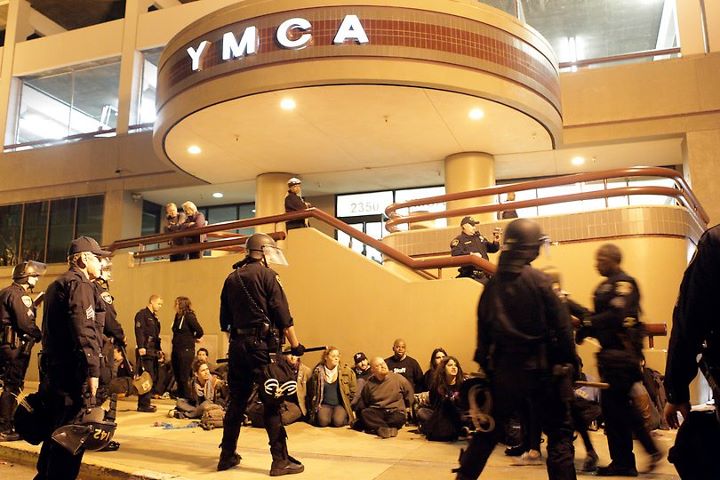
Outside of jail, the conversation seems to have been somewhat different. The focus within the movement over the past week has increasingly been on the brutality that we experienced in jail. We were denied food and necessary medication, leading to seizures; we were abused both physically and verbally; we were crammed into overcrowded and inadequately ventilated cells in which the tear gas that still clung to our clothes made breathing unbearable. All of this is true. This was a traumatic experience for many of us, and the support from cheering crowds waiting with coffee and cigarettes when we were released was powerful. This collective healing is important; it builds solidarities.
But we need to be careful. The discourse about police brutality that has been disproportionately filling the Occupy echo chamber this week is an essentially liberal one, and it tends to mask other problems that surfaced on Saturday. There is always something tautological about the complaint that one was treated badly in jail. It’s jail, after all. To focus on the brutality of the experience as though this is somehow exceptional is to misunderstand the basic function of jails and police forces in society. The violence that we came up against on Saturday is the violence that is required daily to maintain and reproduce society as it is presently constituted. What we experienced for a few nights, while awful, is simply daily life for the unpaid prison laborers who cleaned out our cells when we went home.
I know that this will not strike most of the people that were arrested on Saturday as a particularly controversial point. Many of them are no strangers to the penal system themselves. Indeed, Oakland’s radical edge within the Occupy movement largely comes from the fact that the quotidian violence that is required to reproduce capitalism is closer to the surface here than in many other communities.
But there comes a point at which these conversations can hinder further thought. I don’t want to normalize or apologize for the brutality of the system, nor do I want to lapse into a debate over what constitutes an “authentic” experience of this brutality. Nevertheless, we as a movement have to stop and ask ourselves what conversations are being displaced by this exclusive focus on police brutality. More than that, we have to look at this focus as itself a symptom of deep contradictions in our practice, which we have been unable to come to terms with.
Chief among these is the fact that up until now Occupy has experienced its growth spurts as a result of confrontations with the police. The general strike in November was in large part made possible by the excessive force with which the police evicted the campers at Oscar Grant Plaza. Similarly public instances of brutality at UC Berkeley and UC Davis led to massive mobilizations on all campuses across the UC system. The basic premise underlying Saturday’s action was in keeping with this pattern. By picking a sufficiently ambitious target and casting the action in sufficiently antagonistic rhetoric, a confrontation was with cops was assured.
Organizers were ready for this. I was ready for this. If “Move-in Day” was successful, so much the better – if not, the inevitable clash with cops would unmask the absurdity of a system that would use such force to keep an empty building from becoming a community center.
The problem is that police forces can adapt. On Saturday there was no dramatic image that crystallized the brutality of the police state, just a whole lot of the standard violence that is inherent to the nature of policing. Even the teargassing of children is, by this point, more or less normal. Whether we admit it or not, we were implicitly relying on the spectacle of police brutality to catch national attention. This didn’t happen as it did in November. And it couldn’t happen, precisely because it already happened in November.
When this narrative of victimization was not immediately forthcoming, we kicked into high gear to manufacture one. This is ultimately what underlies the focus on brutality. It’s not that anything that is being said about our experiences in Santa Rita Jail is incorrect, and of course we need to denounce police brutality wherever it exists. The National Lawyers Guild class action lawsuit should go forward, and for those who had their first material encounter with the violence of the state, the lessons learned last weekend can only have a radicalizing effect. But we also need to understand why this essentially liberal discourse about reining in police excesses has become so hegemonic amongst radicals. It points to a deeper problem within Occupy: so many of our actions are premised on producing narratives for liberal consumption. Scott Olsen was one such story. The attack on students on the “Mario Savio Steps” in Berkeley is an even clearer example. These can be useful organizing tools when they present themselves but they cannot be the basis of the actions we plan from here on out.
I don’t want to gloss over the huge advances that Occupy Oakland is continuing to make. There has been a chronic problem with building occupations in the recent past. Typically, the bulk of planning goes into the actual takeover of a building, while the question of what to do with the space once it’s occupied is an afterthought. Saturday’s action marked an advance insofar as there was clearly a tremendous amount of work that had gone into “planning for success.” A schedule of events was made, materials were gathered, and it seemed like there were the numbers to sustain an indefinite occupation. But at a more fundamental level, success was not the point. It was more or less a contingency plan for what to do in case we accidentally succeeded. The romanticized confrontation was still the unconscious premise of our actions, no matter how many people outwardly believed we would win the day.
In the holding tanks of Santa Rita, we discussed these questions. Many of us were coming to grips with the recognition that we went into Saturday thinking that there was a crew of radicals in Oakland who had it all figured out. All we had to do was show up at their event and things would go off without a hitch, which is how it had worked at the general strike and the port shutdown.
This logic broke down on Oak Street. Saturday clearly demonstrated the limits of a mode of organizing that has thus far been successful. Up until now, Occupy has involved a contradictory and unstable mixture of liberal and more radical elements held together by a thin tissue of stories of injustice and violated “rights.” This fact has led to endless unproductive disputes about the role of “violence” in our movement, of which Chris Hedges is just the most recent and banal example. The problem is that if our unity can be reduced to our shared victimization, we are reliant on police and civic officials to continually give us these stories. As police tactics adapt, and as the demands we make of the system become more radical, this will become increasingly difficult. The basis of the connections we make within the movement must involve a deeper sort of radicalization. The central antagonism is not between the police state and the people, but between labor and capital. The anti-police repression marches that are now happening weekly in Oakland, while focused on a crucial issue, tend to sideline this larger point. To the extent that this discourse dominates our practice, we are operating with exactly the same limited and moralizing conception of our movement’s unity as our liberal critics. The romanticized picture of the brutal repression of peaceful demonstrators that Hedges fetishizes is on a continuum with the images of victimization in many of our own actions. We need to tell a new story.
After we experienced the material limits of this type of organizing, some very necessary conversations began in Santa Rita in earnest. The focus on the brutality has its uses, but to the extent that it stands in as a substitute for this more substantial self-criticism, it allows the tenuous alliance between adventurism and humanitarian liberalism to persist. While we are all justifiably angry at the Oakland Police Department and the Alameda County Sheriffs, what comes out of this experience needs to be more than simply a strengthened conviction that we hate the cops. If we don’t swiftly move towards the self-criticism that we need, the opportunity will be missed.
Jeb Purucker is a graduate student in Literature at UC Santa Cruz and a member of UAW Local 2865.


Jeb, we can’t tell a new story because the one we began to tell last September is still running its course. The narrative is still in its infancy. This is the story that will help tell the next one, the one you’re pointing to when you say, “The central antagonism is not between the police state and the people, but between labor and capital.” As you point out, there will come a time, maybe soon, when there will be no need to depend on supplying spectacle to the liberal media to get our message across. Radicalization of the Occupation should take us away from the idealized “anarchism” and future christian-like utopia of the Chris Hedges in the movement and into the clear contradictions of the class struggle.
Posted by Jesus del Rio | February 6, 2012, 3:44 pmthe move to generalize from occupy wall street to occupy the corporations
is not a narrative change its a development
i take the cap v labor nucleus of struggle to suggest that diretion of story development
Posted by paine | February 7, 2012, 6:20 pmIf you’re suggesting that “development,” because of the dialectical nature of the struggle, is a better word to use than “change,” I will agree. But I was using “change” in Jeb’s original context.
Labor vs capital is more than occupying, the aim is to ultimately destroy the corporations–whose sole interest is to accumulate wealth and rule over us–and build a new society based on human needs. To do this we must take the side of the only REVOLUTIONARY social class, the workers, and make their struggle for a HUMAN, just society ours.
Posted by Jesus del Rio | February 7, 2012, 7:05 pmNicely put Jeb – to emphasize fighting the police almost seems an entry-beginning-adolescence into the process of fighting the system they support and maybe one that we can move on from — is that what you mean? is that the liberal in radical clothing?
It strikes me this way because I don’t see clashes with the police as potentially generative of actual military victory – they are either radicalizing tools, publicity stunts (at times quite effective) or (when chosen by only a small group in a big crowd), potentially marginalizing of a broader movement
Posted by josh brahinsky | February 7, 2012, 12:02 amin other words, – of course the police are violent – of course jails suck – are these realizations part of important learning? or important publicity? do we need to reiterate them? and what is the next lesson – or how do we learn it?
Posted by josh | February 7, 2012, 12:23 amI think that Mr. Purucker is right that a logic of confrontation undergirds the Occupy movement. But I don’t think it is at all correct to suggest that it is an “unconscious premise,” as if it were strategically chosen by Occupy Oakland (or Wall Street) or whatever. It is more of an environment or terrain than it is a premise. Is there the possibility of a social movement that does not involve confrontation with the state? When we look at the present wave of struggles — in Egypt, Chile, South Africa, Spain, Greece, wherever — do we see examples of alternative paths? I think that, rather, the logic of confrontation is structural. It has to do with the character of capitalism. There is no real way *around* the state, at present. Questions of strategy then become questions of how we relate to this terrain. . .
Posted by Jericho Black | February 7, 2012, 9:32 amWhile there’s much to agree with here, it’s hard to see how, to stick to the terms of the analysis, the central struggle isn’t labor and the sub-proletariat and capital, especially in Oakland. Ignoring the power of the sub-proletariat to generalize social antagonism in order preserve a simple dialectic that posits negation as within a supposed whole of social relations which is in fact only part of a bigger set seems to limit tactical possibilities here.
Posted by totalizingcritique | February 7, 2012, 10:23 amcan you say that again more simply – i wanna understand – but i dont
Posted by josh | February 7, 2012, 10:27 amWhat Josh said. I taught social theory for ten years I don’t get what you mean.
Posted by Chris | February 7, 2012, 11:44 am“While there’s much to agree with here, it’s hard to see how, to stick to the terms of the analysis,…”
“can you say that again more simply – i wanna understand…”
“I taught social theory for ten years I don’t get what you mean…”
oh woe oh me oh …
I suppose I shouldn’t answer for Jeb Purucker but… what the hell. Did you careful readers miss this?
“The central antagonism is not between the police state and the people, but between labor and capital.”
How about all caps? I know, it’s obnoxious, but I guess sometimes obnoxious is necessary:
THE CENTRAL ANTAGONISM IS NOT BETWEEN THE POLICE STATE AND THE PEOPLE, BUT BETWEEN LABOR AND CAPITAL.
Get it?
Posted by Capitalism or Democracy-Choose One | February 7, 2012, 12:56 pmThe questions of the last two folks that you quoted were not directed at Jeb, they were directed at the author of your first quote.
Posted by bankrobber | February 7, 2012, 2:24 pmThe problem with this statement is that it implies that the police state is somehow separate from capital rather than “a committee for managing the affairs of the whole bourgeoisie.” In other words, how does one confront capital without at once confronting the state? I don’t see many examples — historically, at present, whatever — of attacks on capital which don’t at once bring the state into play.
Posted by Jericho Black | February 8, 2012, 3:08 pmNot in the US. Simplistic paleo-Marxist analysis is at best useless, reflecting as it does a peculiar kind of political nostalgia. It’s not the 1880s anymore, or even the 1930s.
Posted by Oliver Hellenbach | February 13, 2012, 10:31 amOh, really? “Paleo” and “nostalgic,” just because you said so? And how “paleo” and “nostalgic” is this other “cliche”: “Workers of the world unite. You have nothing to lose but your chains and a world to win?”
Too simplistic? Not enough to scare the shit out of the 1%? Sounds like an old wasted dream to you, Oliver, or not revolutionary enough?
Posted by RaulReyes | February 13, 2012, 11:02 amNo, it’s paleo and nostalgic because it consists mostly of rhetoric and tactics that arose from and were applicable to a set of objective conditions on the ground that no longer apply. As one example, the US doesn’t face a situation where an oppressed urban proletariat are working their butts off for next to nothing to make cigar-smoking top-hatted capitalists rich while police and/or hired thugs prevent strikes or labor organization. Rather, a huge number of the urban poor have either minor and easily-replaced roles or no role at all in the modern US economy, which would frankly be materially better off if a whole bunch of them were simply to disappear entirely from the face of the earth. And they lack the political, economic, or social means to become economically relevant. This is really quite different. (Harry Bridges recognized the direction of things 50 years ago when he negotiated a contract to allow attrition of the longshoremen’s workforce via automation and improvements in technology while guaranteeing their wages would rise with overall productivity. He used to say, “At this rate, by the year 2000 there will be one longshoreman on the West Coast. But he’ll be the highest-paid son of a bitch in the United States.”)
As an example of similar nostalgic fantasies at the other end of the political spectrum, consider the claim of pro-gun fetishists that it’s the Second Amendment and the private ownership of weapons that stands between us and (a) foreign invasion and (b) domestic dictatorship. And while they polish their deer rifles in self-congratulation, other forces continue to rapidly de-democratize the political system.
Just as the 1% aren’t worried about gun-cult lunatics like Timothy McVeigh and his ilk (or their pale imitations in the Tea Party) putting an end to their privilege and their grip on the political system, neither are they quivering in their boots by the chanting of 150-year-old slogans or the threat of workers on the barricades a la the Paris Commune. At this point they’re a lot more worried about legislative action to increase their taxes or restrict their financial schemes than about the rising of the proletariat waving the Communist Manifesto or whatever other document-based fetish you might prescribe. And they’re probably delighted that backward-looking firebrands manque are muddying the waters and wasting the energy of the potentially politically-engaged with continued rants against the outrages of the 19th and first half of the 20th century.
Posted by Oliver Hellenbach | February 13, 2012, 12:34 pmTC, I don’t think we should be making a distinction between “labor” and the “subproletariat.” Marx defines the proletariat as the class that is the dissolution of classes–because it absorbs all the other classes below the capitalist class, like the peasant/small farmer class, the self-employed artisan, and so on–and because as the “universal” class, possessing only its power to work, its dispossession is radical. Bordiga further defines the proletariat as the class of “those without reserves” (i senza-riserva). The last decade has seen the reproletarianization of the “middle-class” layers of the working class via asset-stripping–the loss of their reserves. The back-to-the-wall struggle of the Wisconsin public workers last year that led to the occupation of the state capitol was the signal that this process was well advanced. I could be wrong, but the statistics suggest that the roughly 30% of the US proletariat that is “working poor”–people who work for wages but don’t earn enough to live on–blends pretty seamlessly into the unwaged, which is the layer I assume you’re referring to as the subproletariat. Between the minority of stably employed, benefit-receiving workers (“labor”) and the desperate bottom layers are the “precariat”–the casualized workforce, some of it skilled and educated, who more or less manage to get by. What I believe we began to see in October and November in Oakland was a tentative indication of class recomposition–a nascent alliance between the remains of “organized labor” and the rest of the working class and the unwaged. This is only possible because the stable “middle” working class is rapidly losing its reserves. Finding the strategy that will bring these layers together in common struggles for limited objectives is the task of the hour. If Longview happens, it will be an important step forward in the process.
Posted by Adam Cornford | February 7, 2012, 9:09 pm“without reserves” is Marx’s characterization, not Bordiga’s, just fyi.
Posted by Jericho Black | February 8, 2012, 1:15 pmalso, longview already happened — local 21 and EGT decided made nice and signed a contract. quelle surprise!
Posted by Jericho Black | February 8, 2012, 1:17 pmReblogged this on JHNConnect.
Posted by James Jr | February 7, 2012, 12:33 pmWhile all in all not a bad article, something gets lost in the mix here, which is that even if the police prevented OO from seizing the convention center, and this was to an extent predictable, that doesn’t reduce the meaning of the action to a confrontation with police. The purpose of the event was still to communize a building for the community, and in this it still had as its focus the contradictions of capitalist property relations. It’s not the same thing as organizing the unemployed, the precariat, or the undocumented into mass class actions, but that doesn’t mean it’s reducible to a grudge match with the Oakland pigs either. As to whether the FTP march plays a positive role in anticapitalist struggle, it would seem that a precondition of mounting a serious struggle against capitalist social relations does imply a clear demarcation between the repressive state apparatus and those with whom one is in solidarity. You cannot afford to confuse these things. So if this march helps to insist on this dividing line, it serves a function. Which means at the end of the day, neither the move-in day nor the FTP marches should be seen as a ‘distraction’ from the main antagonism, i.e. between labor and capital (though that presumes that labor isn’t permeated through and through by capitalist forms of life). It just means there’s a lot of other things one can be doing at the same time, and in the future. To think that you can struggle against capitalism without struggling against the police-state-prison apparatus that ensures its reproduction is absurd.
Posted by Kieran | February 8, 2012, 4:27 pmThis is by far the best piece I’ve seen on the current situation. However, Jeb fails to acknowledge that the tenuous alliance of liberals and radicals has been SIMULTANEOUSLY the strength and the weakness of Occupy. He seems to want to dissolve this alliance in favor of a “new story” about the antagonism between labor and capital.
No, the contradiction between labor and capital remains largely submerged at this historical moment, in the US anyway, and whatever we may wish or do, there is little indication that it will emerge into the open any time soon. If you agree with that assessment, you are left with an (essentially populist) antagonism between the 99% and the 1%. I say let’s be happy with what we got and make it work, i.e. use our “revolutionary imagination” to further the 99% movement. OWS emerged from that imagination (Ad Busters’ fantasy and Graeber & friends’ acting it out). So did the imaginative (hyperreal?) Oakland “General Strike”. Much has been accomplished. “Changing the conversation” is no small achievement.
But the time for communization — should it come — is when the social order is really breaking down, when capitalism can no longer meet basic needs and masses of “ordinary people” see their very survival at stake. That time is not now. A couple of thousand activists — including some very smart, well-read UC Santa Cruz graduate students — do not a revolutionary proletariat make.
I know that when you live in an insane asylum, it is tempting to “want a revolution, and want it NOW!!!” I say, maintain your sanity. Don’t replay the sixties.
Posted by RB | February 8, 2012, 5:17 pmThe police are the branches of the capitalist tree, not the corporate or legislative root. Pruning the branches that represent 99% of the tree still allows the 1% to grow strong.
Posted by Rosalee Wollman | February 9, 2012, 2:10 pmAn excellent article and yes, it has niggle points but it is cogent and well thought through. I feel at a distinct disadvantage to the other people commenting on this post. If I may, I want to offer my opinion for what it is worth.
My point is this: Occupy is the result of the pushing down of a significant population (the aspirational lower middle class) to their own detested level of ‘proletariat’ having had their reserves and their accumulated savings wiped out as part of an exercise that serves no purpose but to promote one currency over another. This group has caused Occupy to take the form it now possesses.
This significant group has joined in the overall protest movement and has tempered the approach to protest so much as to cause the enormous dichotomy between protest approach and police response. This is a tactic that reveals a diminishing return as the blog states (police adapt to these tactics and temper their response too) and, against the wider context of the protesters of the Arab Spring dealing with much higher odds and greater risks, Occupy is suffering from a ‘competition’ that is more sympathetic and more newsworthy.
For Occupy to adapt, to progress and to generate a new tactic it requires a digestion of the facts of the protest to date and an acknowledged comparison with historical parallels. What I am seeing is an effective checkmate or Mexican stand-off. Neither side wishes to escalate the intensity of engagement understanding that, to do so, would result in a ‘loss’ for their agenda. This situation threatens a voluntary movement more than it does a professional security body. Occupy may compete for arts and community centres all over Oakland but that is a cul-de-sac because such a venture could quite legitimately be negotiated at the endgame with no objections. These ‘battles’ do little to promote Occupy as a serious movement for cultural change and actually may harm the overall movement focusing on stunts that are transparently contrived to elicit an emotive response when the news also covers the actual bloody massacres of protesters for democracy. THAT is the point of this article in my opinion and I think it is a very timely and relevant point.
Acting out simulated horror when very real atrocities are being enacted elsewhere undermines any credibility the movement might hope to engender with their target audience. They, the electorate that rewards or punishes the representatives of the powers that be, are the ultimate point of the Occupy exercise otherwise it would be a simple case of targeted assassinations, right?
I believe the time has come to acknowledge that the initial message of Occupy has been adequately delivered. The central point of Labour V Capital is the guiding star. Exposing the obvious is pointless; banks acquire, that is the nature of banks. What is pernicious is the influence Capital has upon the ‘governance’ of Labour. This is the pressure point that needs a squeeze. The lobby system within US and UK politics is the actual agent of influence and it has remained largely untouched, unnamed and unfrustrated. Add to this, the false war between the two main parties in the US which preserves a dysfunctional political system from a bygone age (GOP V Democrat = Whigs V Tories in 19th Century UK politics) and we have some framework in which to increase the political representation for diverse constituencies and improve the overall function of the State to better reflect the reality of life in the West.
What is at stake is the RIGHT to participate meaningfully in our society as opposed to selecting the colour of the window dressing. For this right to be earned the amazing social experiment in group networked sentience that is Occupy must continue but I assert that the prize is a society that is robust and expansive in as non-toxic a manner to our habitat as we can make it not the destruction of the powers that be.
Occupy is not simplistic Anarchy but considered socially powered rejection of an inherited oppression. The next level of action must reflect an acknowledgement of this reality and the ‘victim’ mentality must be done away with. From now on, I urge Occupy Oakland and other movements for social change to target their action in such a manner that the overall society is not punished and that those agents that cause harm are immobilized.
I am, as always, contactable.
Posted by Garalt Canton | February 10, 2012, 6:03 pmI took part in J28 from noonish to 4 PM, and left right before the “battle for Oak Street” feeling dismissive of the shield-bearing anarchists. Now I feel I should have stayed. Lots of different feelings about it all. Great article and I have sent it on to a friend. BUT I do not agree that “THE CENTRAL ANTAGONISM IS NOT BETWEEN THE POLICE STATE AND THE PEOPLE, BUT BETWEEN LABOR AND CAPITAL.” I think the “central antagonism” or to put it into my own words, the core struggle, is between ideology/abstraction and lived experience. The power of the occupy movement, imo, is not its ideas – there’s been plenty of anticapitalist analysis, dissent, organizations etc over the decades – it is the actual, physical reality of being together, sleeping and eating and talking and smoking and meditating and sharing space and marching (strolling, really, most of the time) and being face to face and shoulder to shoulder. That’s why the encampments were a heresy to the Existing Order and “had” to be smashed – not because they were so dangerous to regular people, but because they were a practical example of what those regular people could do for and with each other, and the example spread quickly, as goofy/iffy/tenuous as a bunch of strangers suddenly camping on the concrete in cities was/is. “Labor and Capital” — what does that mean to anyone, really? I know, I can look it up and read and actually I am familiar with these concepts and I got a history degree at UC Berkeley and all that. The “central antagonism” is between the Few with Too Much and the Many with Not (Quite) Enough, or Not (Even Close to) Enough, and the Stocky Blue Line between them, enforcing the will of the Few to try to express it less abstractly.
But of course arguing against abstraction while using words is an absurdity, a paradox.
Posted by Janet Weil | February 10, 2012, 6:55 pm