 Viewpoint Magazine
Long before the Haymarket Massacre, May Day represented a time of transition. Winter had receded; in anticipation of the wealth of summer, the people opted for leisure over work. The holiday shifted from “green” to “red” when leisure was attacked, work violently imposed, and wealth expropriated.
May Day 2012 was another kind of transition – to what, nobody knows. We have witnessed dramatic shifts in the Occupy movement, fragmentation into factions, and confusion and constant debate about tactics. Yesterday permitted marches took place alongside street confrontations, as though both were in separate worlds. The Mission in San Francisco saw a peak in property destruction the night before, and Seattle partied like it was 1999.
The state, unsure of the nature of this movement and puzzled by the popular disgust at police brutality, has managed to respond with an unusual combination of incompetence and efficiency. Emergency orders in Seattle allowed police to confiscate any item they deemed to be a weapon. In Oakland, some of the most dedicated militants of the movement were targeted for violent arrest throughout the day. The crowd managed to “de-arrest” their comrades on one or two occasions, but this victory was short-lived. The police must have been disappointed to find that the rhetoric is true: their captives were not leaders, and didn’t have the battle plans in their pockets.
We walked up to 14th and Broadway yesterday afternoon, to see the army of cops that had driven Occupy Oakland out of the plaza. What we saw behind this army was clearly a tank – though an anarchist medic, a former Marine, explained that it was technically an armored personnel carrier. Meanwhile, an FBI agent provocateur has entrapped anarchists in Cleveland, and this morning police raided the San Francisco building occupation, which, against all odds, held 888 Turk for the night.
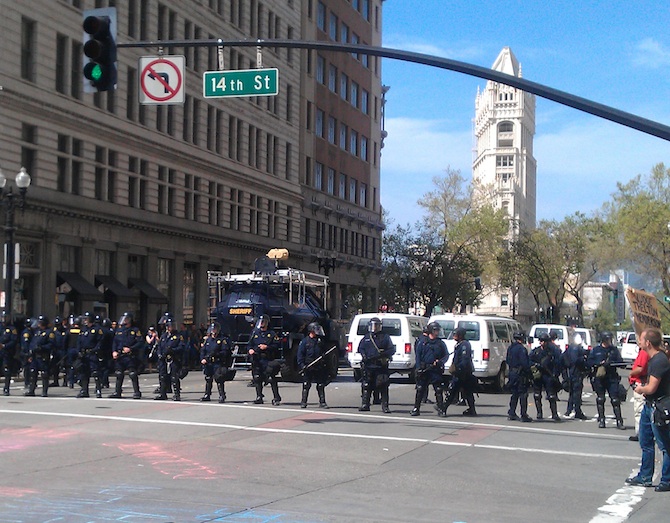
The polarization of the movement has a material basis. Intellectuals go back and forth on Twitter about the police, the black bloc, the best procedure for an illegal building occupation (as though any of us knew!). These debates have very little real content, but they work very well to displace our anxiety: nobody actually knows how a movement can grow and develop today. The classical patterns are out of reach: we don’t have mass left-wing parties, our unions have little influence, and most of our factories have more machines than workers – they remain untouched by general strikes.
I did not see major signs of union participation in the streets of Oakland yesterday, though some did participate in the permitted march. This should not be misinterpreted as a facile opposition between reformist labor unions and radical Occupy activists. The proposal to occupy the Golden Gate Bridge originated with a picket planned by the Golden Gate Labor Coalition. This union group received sanction to strike from the San Francisco Labor Council and the San Francisco Building Trades Council, largely over healthcare costs for bridge, bus, and ferry workers. In the days leading up to May 1st, they withdrew this plan, opting instead to picket the ferry in Larkspur, CA.
The relationship between unions and confrontational anti-capitalists should not be oversimplified. My mind turns to another May, another general strike, and others are surely turning with me. In May 1968 a spirit of wildcat refusal started in Paris and spread throughout France, shutting down the economy and nearly toppling the government. It is sectarian to criticize today’s general strikes as betrayals of tradition, as though past general strikes unfolded according to an angelic pattern framed by union procedures and regulations. The French May was activated by a new conception of political struggle. Student activists had invented new forms and alliances, with their spontaneous action committees and aesthetic insurrections. They opened the language of politics to social groups – women, gays, immigrants, youth – whose demands had so often been excluded from the workers’ movement.
This reinvention of revolution took a paradoxical course. When student occupations of the Universities of Paris were attacked by police, the powerful bureaucracies of the French Communist Party (PCF), and its union, the General Confederation of Labor (CGT), were forced to recognize that rank-and-file sympathies were with the students; they permitted an initial mobilization in protest of police repression, sending 800,000 workers on a one-day strike. The CGT was unable to contain the avalanche that resulted from this encounter. As May continued, ten million workers went on strike, without permission from the union, sometimes occupying their workplaces and kidnapping their bosses.
In June the union’s reluctant acquiescence gave way to an open alliance with the bosses; it would do its best to turn workers against students, and assist the state in returning France to work. In spite of their disgraceful conduct, the role of the PCF and the CGT was contradictory. They did everything they could to block the development of a real class struggle – but against their own intentions, they provided an institutional basis for class solidarity and mass political activity.
In Italy, 1968 lasted for an entire decade. It was again this linking of new social actors, who introduced new demands and political practices, that spurred the traditional workers’ movement – struggling to break free from its own reformist bureaucracies, the Italian Communist Party (PCI) and the General Confederation of Italian Labor (CGIL) – into action. When the factory worker Alfonso Natella was invited to meet with student activists, in Nanni Balestrini’s novel We Want Everything, he said: “what the fuck, I’ve got nothing to lose, I’ll go and see what these turds have to say.”
Perhaps he was prepared to go because he knew that the students themselves had gone through a dramatic evolution, which is traced in Paolo Pietrangeli’s song “Valle Giulia.” It recounts the student clash with the police during the occupation of the architecture department of the Sapienza University of Rome – the same street battle that Pier Paolo Pasolini wrote about in his poem “The PCI to the Young,” siding with the police.
The students start by chanting – loosely translated – “No to the school of the bosses, throw out the government!” But after fighting with the police, they realize that “something new” happened during the skirmish: “we didn’t run anymore.” By the end of the song, their slogan has changed: “No to the class of the bosses! No conditions!”
A revolutionary sentiment was spreading, across different sectors of the class, as Andrea Righi recounts:
In 1968, on a chilly December night, after the police opened fire on farm laborers in Avola in Sicily, Milan students stormed the La Scala theater shouting, “the farm laborers of Avola hope you enjoy the show,” and threw rotten eggs against the wealthy audience.
This change in consciousness was only realized when the students struck their match in the auto factories, and the “Hot Autumn” was ignited – an enormous wave of mass strikes attacking bosses and union bureaucracies alike, giving way to a new kind of social movement in the 1970s. One participant, Sergio Bologna, who had urged “the whole of the students’ movement to measure itself with workers’ struggles,” recalled: “It was in 1969 when the whole movement found itself in front of the gates of FIAT that we had won.” And it was this initial explosion that laid the ground for the famous experiments in social centers and autoreduction often invoked by contemporary activists, peaking in the creative revolt of the autonomous movements in 1977.
But it is hard to find the gates of FIAT today. Where are the massive factories, with workers grounded in the traditions of solidarity, strike, and sabotage? A defection from the workplace at the scale of France and Italy seems utterly unimaginable today, with our marginalized labor movement. We can’t ignore the fact that the decline of reformist social democracy has made it difficult for us to expand beyond a militant minority. However, we also can’t just take the easy way out by ignoring everything that’s changed.
After all, these struggles were firmly situated within cycles of crisis and restructuring – changes in the regime of accumulation that both heightened class antagonisms and reacted against them. One of the crucial theoretical premises of the student movement was that the line between students and workers was getting more and more blurry. The university was becoming a business that generated human capital, rather than a monastery for traditional intellectuals; it shaped a labor-power appropriate for an increasingly technological production process. The classical conditions of full employment, so conducive to strikes, were in decline, giving way to heavily automated factories and creeping joblessness. Social movements had to extend outside the factory, and in Italy they did with some success. But as capital shifted from the Keynesian compromise to neoliberalism, laying off workers, financializing itself, and moving labor-intensive production out of the country, it also imposed new forms of control on workers who were still tied to manufacturing.
This is exactly what happened to the Italian struggles in 1980, after a bitter 35-day strike at FIAT was finally defeated. The state had already violently destroyed the movement and arrested its militants – 5,000 in jail or driven abroad. A hundred workers committed suicide; after mass layoffs, the employers, in alliance with the managerial staff, broke the residual power of the mass worker. The student movement had tried to bring technicians and white-collar workers into the struggle, but now they betrayed the dream of proletarian unity and opted for competition over solidarity. Their ideology of a “right to work” was a justification of managerial power over manual laborers, whose control of the production process was compromised by the introduction of a computerized chain of command. The story is repeated everywhere: subcontracting, multi-tasking, job rotation, temporary and part-time work, stagnant wages – and the decimation of the protection that workers did get from unions and the welfare state.
Now while students look forward to waiting tables to pay off their loans, manufacturing workers – and the service workers who facilitate the “logistics” of manufacturing, like transportation and telecommunications – are still subjected to this labor regime, with severely compromised protection. This is a crucial political difference between our struggles and those of the 1960s and 1970s. While students and workers entered that crisis within the framework of the postwar compromise, we’ve entered our crisis after that framework and its material conditions have been mostly dismantled.
So we have to turn our attention to the conditions, sometimes paradoxical, for the expansion of a genuinely radical struggle to a mass scale capable of a total social disruption. In the past, these conditions were themselves established by struggles before they ossified into reformism – the PCI, after all, came into being after the biennio rosso, the two “red years” of worker-organized factory occupations from 1919-1920. There is no reason to exclude the possibility that pressure from the streets will force institutions like unions to loosen their grip, and get out of the way of an autonomous rank and file. My own graduate student union, UAW 2865, was the site of an electoral battle against the incumbent bureaucratic slate; the winning reform caucus, Academic Workers for a Democratic Union, has gone on to play a vital organizational role in every radical action on the UC Santa Cruz campus.
But a strategic engagement with these contradictory existing institutions can only succeed if we also put forward new ideas, which take the restructuring of the global economy into account, and construct new political practices that can force capital into ceding the historically specific space in which a contemporary movement can explode. These ideas can’t be abstract; they must be actively generated by the real activity of the exploited, as they take the lead and organize themselves. We may have organized ourselves in the public squares, in the tents, but if we simply impose this form on those who are not yet with us, we prevent them from acting.
May Day 2006 saw over a million undocumented workers withdrawing their labor and participation. Starting as demonstrations against the racist bill HR 4437, it built into an immigrant’s strike, what some have called the largest strike in US history. Truckers completely shut down the logistical hub of the Los Angeles/Long Beach port complex. I remember seeing truckers cheering in Oakland during the November 2011 general strike; I saw less enthusiasm during the second port shutdown a month later.
But in 2006, immigrant workers had acted within independent organizations. The troqueros who shut down the port – independent contractors who have to buy their own gas and can’t be unionized by the Teamsters – had started illegally striking and shutting down traffic in late April. The North Carolina meatpacking factory Smithfield had been shut down by workers who organized in Latino “workers’ centers,” outside of the unions, adapting the model of community centers to workplace organizing. Their call for a May Day walkout spread to meatpacking plants across the state. If mass strikes once rolled from factory to factory, can we imagine a chain of actions today that links one sector of the proletariat to the next, waves of self-activity articulated in radically different organizational forms?
It means taking risks. But that’s the only way that our movement can begin to discover the possibilities of emerging forms of struggle – like the bums of the Industrial Workers of the World who jumped on a moving train, to see where it would take them.
 is an editor of