By James Cersonky. The $8.25 man, Bloomberg News wrote in December, has worked at McDonald’s for twenty years. Still, he can’t get forty hours a week or anything more than minimum wage. He can’t make rent payments, can’t afford a computer, and has to go to the Apple store to update his Facebook. After picking cigarette butts out of a bathroom drain, he has to clean off before his next job—at another McDonald’s. But who is the $8.25 man? In the popular imagination, the $8.25 man is, unfortunately, what you see on TV: younger and less child-dependent than the growing majority of his real-life counterparts. He is also, unlike the central figure of Bloomberg’s well-traveled, well-narrated piece, statistically unlikely to be a man. Nationally, women make up 66% of food preparers and servers, 70% of waiters and waitresses, and 74% of cashiers. Continue reading
By Donald V. Kingsbury. The news from Caracas has not been promising for some time. The leader of the Bolivarian Revolution had not been seen since early December, when he travelled to Cuba to undergo emergency surgery for a still undisclosed form of cancer. On Tuesday March 5, Vice President Nicolás Maduro announced that Venezuelan President Hugo Chávez died in a military hospital in Caracas. He was 58 years old. Continue reading
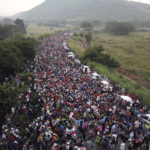
By Pat Cabell. On July 1st, 2012, the day of Mexico’s recent presidential election, I visited the Museo de Arte Moderno in Mexico City, hoping to encounter a painting by Remedios Varo. A surrealist painter fleeing the Spanish Civil War, Varo was among the many notable exiles to make their home in Mexico City during the mid-20th century. I hoped that through one of her Cimmerian dreamscapes I might learn something about the political situation she experienced in the aftermath of the massive Mexican revolutions of 1910 to 1929. It was during the prime of her career following the end of WWII that the Institutional Revolutionary Party (PRI), inheritors of the Mexican Revolution, strayed decidedly off-course to embrace a particular brand of oligarchic and authoritarian governance. Their 71 years of uninterrupted rule ended in 2000, but as I arrived at the museum that morning their return to power, in the context of an increasingly bloody “Drug War,” was already presumed. Continue reading
The second issue of Viewpoint, Theory and Practice, is now online. Continue reading
By Amanda Armstrong. We’re passing through a low phase in Northern California – a lull that partially parallels those facing organizers from Madison to New York. The rebellious energies so evident recently seem scattered these days, dormant. The universities are quiet. And the forces that had gathered in city parks and squares, most massively at Oakland’s Oscar Grant Plaza, are largely absent. The encampments are broken up, the assemblies dissolved. Continue reading
By Elise Thorburn. It took a little while for the student struggle in Quebec to gain traction with activists outside of the province. The strike began in February, but it probably wasn’t until late March that activists in Ontario paid it much mind, and not until late April or May that large numbers of people began pouring across the borders into Quebec to demonstrate alongside the Quebecois, to talk to Quebec activists, and to learn from their organizing tactics and struggles so that we could push the movement beyond the confines of the Francophone province and into the rest of Canada. Continue reading
By Gigi Roggero. We’re living in a revolutionary situation. We could reformulate the classical definition in the following terms: the ruling elites of the global capital cannot live as in the past; the workers, the precarious, the students, the poor, the living knowledge refuse to live as in the past. In the global crisis, the transnational struggles – from the North Africa insurrections to the acampadas in Spain or Syntagma Square, from the Chilean university movement to Occupy and the Québec uprising – are composed by the convergence of a downgrading middle class and a proletariat whose poverty is directly proportional to its productivity. In this context, the university is a key site. Continue reading
By Ben Webster and Daniel Marcus. May Day was a gamble for Occupy Wall Street, and a necessary one. Instead of heralding a national renewal, springtime has found Occupy short of ideas and running on vapors. Life after the encampments has not led to a generalization of occupations, and the prospect of reestablishing them in their initial form is remote. The 1st of May was logical timing for a revival – or at the very least, a lifeline, a confirmation of vitality, an open door. Bolstered by the call for an expanded general strike, May Day 2012 smelled of hope, but also desperation. Our sense at the outset was that failure in the streets – whether the result of low turnout, police out-maneuvering, or flat repetition of gesture – would radiate far beyond New York, effectively bringing the movement to an impasse. Although our fears ultimately proved unwarranted, there was little in our experience of May Day that augured an escalation of struggle; no spark to set the summer ablaze. Continue reading
First entry in an exchange with Jacobin, by Asad Haider and Salar Mohandesi: “We all wondered, as we watched Back to the Future, how alternative futures could change the whole universe while Marty McFly stayed the same. Those movies amounted to a Reaganite philosophy of history: the short-circuit between the Fifties and the Eighties which converts every contingent encounter into one reactionary loop, centered on the white man who secretly invents rock n’ roll, seduces his mother, and conquers the space-time continuum.” Continue reading
Viewpoint was invited to debate Lenin’s State and Revolution in a panel at the Left Forum. Check it out if you’re near New York City this weekend. Details below. Continue reading